


Page 188 - Clinical Anatomy
P. 188
ECA3  7/18/06  6:45 PM  Page 173


                                                       The bones and joints of the upper limb  173


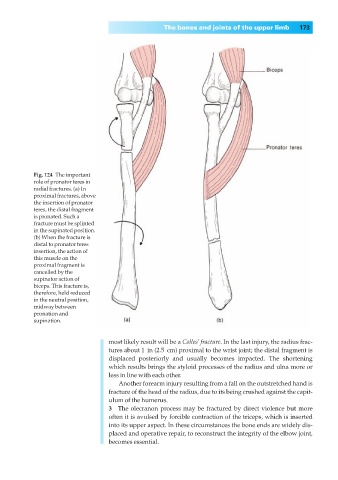
                  Fig. 124◊The important
                  role of pronator teres in
                  radial fractures. (a) In
                  proximal fractures, above
                  the insertion of pronator
                  teres, the distal fragment
                  is pronated. Such a
                  fracture must be splinted
                  in the supinated position.
                  (b) When the fracture is
                  distal to pronator teres
                  insertion, the action of
                  this muscle on the
                  proximal fragment is
                  cancelled by the
                  supinator action of
                  biceps. This fracture is,
                  therefore, held reduced
                  in the neutral position,
                  midway between
                  pronation and
                  supination.


                                        most likely result will be a Colles’ fracture. In the last injury, the radius frac-
                                        tures about 1 | in (2.5 | cm) proximal to the wrist joint; the distal fragment is
                                        displaced posteriorly and usually becomes impacted. The shortening
                                        which results brings the styloid processes of the radius and ulna more or
                                        less in line with each other.
                                          Another forearm injury resulting from a fall on the outstretched hand is
                                        fracture of the head of the radius, due to its being crushed against the capit-
                                        ulum of the humerus.
                                        3◊◊The olecranon process may be fractured by direct violence but more
                                        often it is avulsed by forcible contraction of the triceps, which is inserted
                                        into its upper aspect. In these circumstances the bone ends are widely dis-
                                        placed and operative repair, to reconstruct the integrity of the elbow joint,
                                        becomes essential.

