


Page 189 - Clinical Anatomy
P. 189
ECA3  7/18/06  6:45 PM  Page 174


                 174  The upper limb


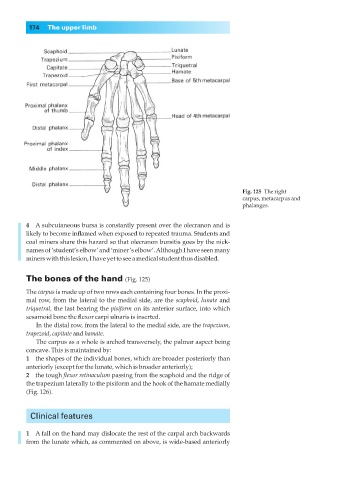
                                                                              Fig. 125◊The right
                                                                              carpus, metacarpus and
                                                                              phalanges.

                4◊◊A subcutaneous bursa is constantly present over the olecranon and is
                likely to become inflamed when exposed to repeated trauma. Students and
                coal miners share this hazard so that olecranon bursitis goes by the nick-
                names of ‘student’s elbow’ and ‘miner’s elbow’. Although I have seen many
                miners with this lesion, I have yet to see a medical student thus disabled.


                The bones of the hand (Fig. 125)
                The carpus is made up of two rows each containing four bones. In the proxi-
                mal row, from the lateral to the medial side, are the scaphoid, lunate and
                triquetral, the last bearing the pisiform on its anterior surface, into which
                sesamoid bone the flexor carpi ulnaris is inserted.
                   In the distal row, from the lateral to the medial side, are the trapezium,
                trapezoid, capitate and hamate.
                   The carpus as a whole is arched transversely, the palmar aspect being
                concave. This is maintained by:
                1◊◊the shapes of the individual bones, which are broader posteriorly than
                anteriorly (except for the lunate, which is broader anteriorly);
                2◊◊the tough flexor retinaculum passing from the scaphoid and the ridge of
                the trapezium laterally to the pisiform and the hook of the hamate medially
                (Fig. 126).


                 Clinical features

                1◊◊A fall on the hand may dislocate the rest of the carpal arch backwards
                from the lunate which, as commented on above, is wide-based anteriorly

