


Page 288 - Clinical Anatomy
P. 288
ECA5  7/18/06  6:50 PM  Page 273


                                                           The tongue and floor of the mouth    273


                                       embryological origin of the thyroid (see page 286). Immediately in front of
                                       the sulcus lie a row of large vallate papilliae.
                                          The under aspect of the tongue bears the median  frenulum linguae;
                                        the mucosa is thin on this surface and the lingual veins can thus be seen
                                        on either side of the frenulum. The lingual nerve and the lingual artery
                                        are medial to the vein but not visible. More laterally can be seen a fringed
                                        fold of mucous membrane termed the  plica fimbriata. On either side of
                                        the base of the frenulum can be seen the orifice of the submandibular
                                        duct on its papilla. Inspect this in a mirror and note the discharge of saliva
                                        when you press on your submandibular gland just below the angle of
                                        the jaw.


                                       Structure
                                       The thick stratified squamous mucosa of the dorsum of the tongue bears
                                       papillae over the anterior two-thirds back as far as the sulcus terminalis.
                                       These papillae (particularly the vallate) bear the taste buds. The posterior
                                       one-third has no papillae but carries numerous lymphoid nodules which,
                                       with the palatine tonsils and adenoids, make up the  lymphoid ring of
                                       Waldeyer.
                                          Small glands are scattered throughout the submucosa of the dorsum;
                                       these are predominantly serous anteriorly and mucous posteriorly.
                                          The tongue is divided by a median vertical fibrous septum, as indicated
                                       on the dorsum by a shallow groove. On each side of this septum are the
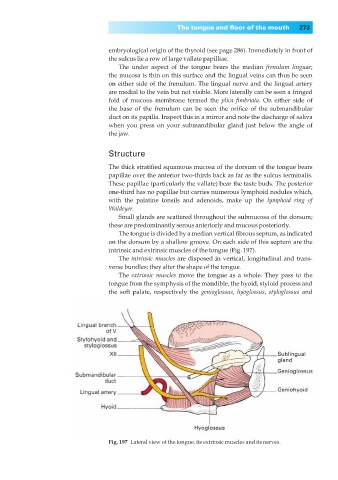
                                       intrinsic and extrinsic muscles of the tongue (Fig. 197).
                                          The intrinsic muscles are disposed in vertical, longitudinal and trans-
                                        verse bundles; they alter the shape of the tongue.
                                          The  extrinsic muscles move the tongue as a whole. They pass to the
                                        tongue from the symphysis of the mandible, the hyoid, styloid process and
                                        the soft palate, respectively the  genioglossus,  hyoglossus,  styloglossus and


                                        Fig. 197◊Lateral view of the tongue, its extrinsic muscles and its nerves.

