


Page 382 - Clinical Anatomy
P. 382
ECA6  7/18/06  6:54 PM  Page 367


                                                                          The cranial nerves   367


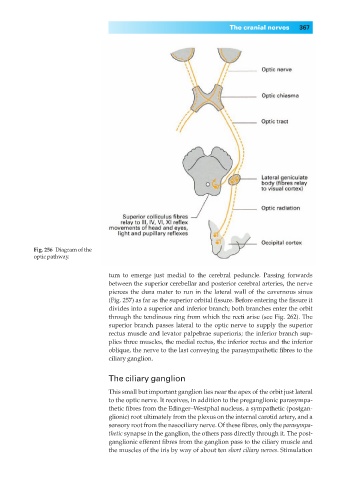
                  Fig. 256◊Diagram of the
                  optic pathway.


                                        tum to emerge just medial to the cerebral peduncle. Passing forwards
                                        between the superior cerebellar and posterior cerebral arteries, the nerve
                                        pierces the dura mater to run in the lateral wall of the cavernous sinus
                                        (Fig. 257) as far as the superior orbital fissure. Before entering the fissure it
                                        divides into a superior and inferior branch; both branches enter the orbit
                                        through the tendinous ring from which the recti arise (see Fig. 262). The
                                        superior branch passes lateral to the optic nerve to supply the superior
                                        rectus muscle and levator palpebrae superioris; the inferior branch sup-
                                        plies three muscles, the medial rectus, the inferior rectus and the inferior
                                        oblique, the nerve to the last conveying the parasympathetic fibres to the
                                        ciliary ganglion.


                                        The ciliary ganglion
                                        This small but important ganglion lies near the apex of the orbit just lateral
                                        to the optic nerve. It receives, in addition to the preganglionic parasympa-
                                        thetic fibres from the Edinger–Westphal nucleus, a sympathetic (postgan-
                                        glionic) root ultimately from the plexus on the internal carotid artery, and a
                                        sensory root from the nasociliary nerve. Of these fibres, only the parasympa-
                                        thetic synapse in the ganglion, the others pass directly through it. The post-
                                        ganglionic efferent fibres from the ganglion pass to the ciliary muscle and
                                        the muscles of the iris by way of about ten short ciliary nerves. Stimulation

