


Page 406 - Clinical Anatomy
P. 406
ECA6  7/18/06  6:54 PM  Page 391


                                                                          The special senses   391


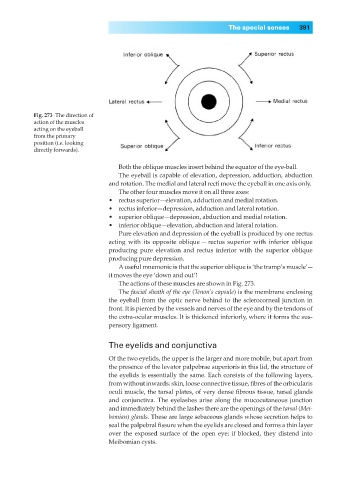
                  Fig. 273◊The direction of
                  action of the muscles
                  acting on the eyeball
                  from the primary
                  position (i.e. looking
                  directly forwards).

                                          Both the oblique muscles insert behind the equator of the eye-ball.
                                          The eyeball is capable of elevation, depression, adduction, abduction
                                        and rotation. The medial and lateral recti move the eyeball in one axis only.
                                          The other four muscles move it on all three axes:
                                        •◊◊rectus superior—elevation, adduction and medial rotation.
                                        •◊◊rectus inferior—depression, adduction and lateral rotation.
                                        •◊◊superior oblique—depression, abduction and medial rotation.
                                        •◊◊inferior oblique—elevation, abduction and lateral rotation.
                                          Pure elevation and depression of the eyeball is produced by one rectus
                                        acting with its opposite oblique — rectus superior with inferior oblique
                                        producing pure elevation and rectus inferior with the superior oblique
                                        producing pure depression.
                                          Auseful mnemonic is that the superior oblique is ‘the tramp’s muscle’—
                                        it moves the eye ‘down and out’!
                                          The actions of these muscles are shown in Fig. 273.
                                          The fascial sheath of the eye (Tenon’s capsule) is the membrane enclosing
                                        the eyeball from the optic nerve behind to the sclerocorneal junction in
                                        front. It is pierced by the vessels and nerves of the eye and by the tendons of
                                        the extra-ocular muscles. It is thickened inferiorly, where it forms the sus-
                                        pensory ligament.


                                        The eyelids and conjunctiva
                                        Of the two eyelids, the upper is the larger and more mobile, but apart from
                                        the presence of the levator palpebrae superioris in this lid, the structure of
                                        the eyelids is essentially the same. Each consists of the following layers,
                                        from without inwards: skin, loose connective tissue, fibres of the orbicularis
                                        oculi muscle, the tarsal plates, of very dense fibrous tissue, tarsal glands
                                        and conjunctiva. The eyelashes arise along the mucocutaneous junction
                                        and immediately behind the lashes there are the openings of the tarsal (Mei-
                                        bomian) glands. These are large sebaceous glands whose secretion helps to
                                        seal the palpebral fissure when the eyelids are closed and forms a thin layer
                                        over the exposed surface of the open eye; if blocked, they distend into
                                        Meibomian cysts.

