


Page 132 - Clinical Application of Mechanical Ventilation
P. 132
98     Chapter 4


                                                    60                        Mechanical Breaths
                                                                              Spontaneous Breaths
                                                    50
                                                  Airway Pressure (cm H 2 O)  30
                                                                                      B
                                                    40
                                                                   A
                                                    20
                                                    10
                                                                                                             © Cengage Learning 2014
                                                     0
                                                                                      4
                                                                             3
                                                          1
                                                                                               5
                                                                   2
                                                   –10
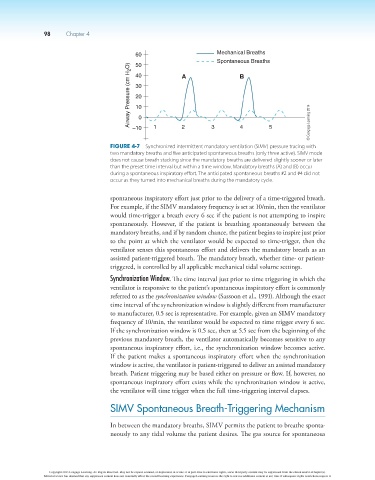
                                            Figure 4-7  Synchronized intermittent mandatory ventilation (SIMV) pressure tracing with
                                            two mandatory breaths and five anticipated spontaneous breaths (only three active). SIMV mode
                                            does not cause breath stacking since the mandatory breaths are delivered slightly sooner or later
                                            than the preset time interval but within a time window. Mandatory breaths (A) and (B) occur
                                            during a spontaneous inspiratory effort. The anticipated spontaneous breaths #2 and #4 did not
                                            occur as they turned into mechanical breaths during the mandatory cycle.


                                            spontaneous inspiratory effort just prior to the delivery of a time-triggered breath.
                                            For example, if the SIMV mandatory frequency is set at 10/min, then the ventilator
                                            would time-trigger a breath every 6 sec if the patient is not attempting to inspire
                                            spontaneously.  However,  if  the  patient  is  breathing  spontaneously  between  the
                                            mandatory breaths, and if by random chance, the patient begins to inspire just prior
                                            to the point at which the ventilator would be expected to time-trigger, then the
                                            ventilator senses this spontaneous effort and delivers the mandatory breath as an
                                            assisted patient-triggered breath. The mandatory breath, whether time- or patient-
                                            triggered, is controlled by all applicable mechanical tidal volume settings.
                                            Synchronization Window. The time interval just prior to time triggering in which the
                                            ventilator is responsive to the patient’s spontaneous inspiratory effort is commonly
                                            referred to as the synchronization window (Sassoon et al., 1991). Although the exact
                                            time interval of the synchronization window is slightly different from manufacturer
                                            to manufacturer, 0.5 sec is representative. For example, given an SIMV mandatory
                                            frequency of 10/min, the ventilator would be expected to time trigger every 6 sec.
                                            If the synchronization window is 0.5 sec, then at 5.5 sec from the beginning of the
                                            previous mandatory breath, the ventilator automatically becomes sensitive to any
                                            spontaneous inspiratory effort, i.e., the synchronization window becomes active.
                                            If the patient makes a spontaneous inspiratory effort when the synchronization
                                            window is active, the ventilator is patient-triggered to deliver an assisted mandatory
                                            breath. Patient triggering may be based either on pressure or flow. If, however, no
                                            spontaneous inspiratory effort exists while the synchronization window is active,
                                            the ventilator will time trigger when the full time-triggering interval elapses.

                                            SIMV Spontaneous Breath-Triggering Mechanism


                                            In between the mandatory breaths, SIMV permits the patient to breathe sponta-
                                            neously to any tidal volume the patient desires. The gas source for spontaneous


                        Copyright 2013 Cengage Learning. All Rights Reserved. May not be copied, scanned, or duplicated, in whole or in part. Due to electronic rights, some third party content may be suppressed from the eBook and/or eChapter(s).
                      Editorial review has deemed that any suppressed content does not materially affect the overall learning experience. Cengage Learning reserves the right to remove additional content at any time if subsequent rights restrictions require it.

