


Page 131 - Clinical Application of Mechanical Ventilation
P. 131
Operating Modes of Mechanical Ventilation  97


                                                      60                        Mechanical Breaths
                                                                                Spontaneous Breaths
                                                      50
                                                    Airway Pressure (cm H 2 O)  30
                                                      40
                                                                  A
                                                                                       B
                                                      20
                                                      10
                                                                                                              © Cengage Learning 2014
                                                       0
                                                                              3
                                                                                        4
                                                                                                 5
                                                                     2
                                                           1
                                                     –10
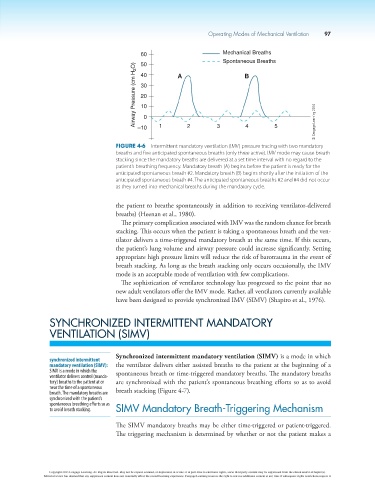
                                             Figure 4-6  Intermittent mandatory ventilation (IMV) pressure tracing with two mandatory
                                             breaths and five anticipated spontaneous breaths (only three active). IMV mode may cause breath
                                             stacking since the mandatory breaths are delivered at a set time interval with no regard to the
                                             patient’s breathing frequency. Mandatory breath (A) begins before the patient is ready for the
                                             anticipated spontaneous breath #2. Mandatory breath (B) begins shortly after the initiation of the
                                             anticipated spontaneous breath #4. The anticipated spontaneous breaths #2 and #4 did not occur
                                             as they turned into mechanical breaths during the mandatory cycle.

                                             the patient to breathe spontaneously in addition to receiving ventilator-delivered
                                             breaths) (Heenan et al., 1980).
                                               The primary complication associated with IMV was the random chance for breath
                                             stacking. This occurs when the patient is taking a spontaneous breath and the ven-
                                             tilator delivers a time-triggered mandatory breath at the same time. If this occurs,
                                             the patient’s lung volume and airway pressure could increase significantly. Setting
                                             appropriate high pressure limits will reduce the risk of barotrauma in the event of
                                             breath stacking. As long as the breath stacking only occurs occasionally, the IMV
                                             mode is an acceptable mode of ventilation with few complications.
                                               The sophistication of ventilator technology has progressed to the point that no
                                             new adult ventilators offer the IMV mode. Rather, all ventilators currently available
                                             have been designed to provide synchronized IMV (SIMV) (Shapiro et al., 1976).


                        SYNCHRONIZED INTERMITTENT MANDATORY

                        VENTILATION (SIMV)


                                             Synchronized intermittent mandatory ventilation (SIMV) is a mode in which
                        synchronized intermittent
                        mandatory ventilation (SIMV):   the ventilator delivers either assisted breaths to the patient at the beginning of a
                        SIMV is a mode in which the   spontaneous breath or time-triggered mandatory breaths. The mandatory breaths
                        ventilator delivers control (manda-
                        tory) breaths to the patient at or   are synchronized with the patient’s spontaneous breathing efforts so as to avoid
                        near the time of a spontaneous   breath stacking (Figure 4-7).
                        breath. The mandatory breaths are
                        synchronized with the patient’s
                        spontaneous breathing efforts so as
                        to avoid breath stacking.  SIMV Mandatory Breath-Triggering Mechanism

                                             The SIMV mandatory breaths may be either time-triggered or patient-triggered.
                                             The triggering mechanism is determined by whether or not the patient makes a


                        Copyright 2013 Cengage Learning. All Rights Reserved. May not be copied, scanned, or duplicated, in whole or in part. Due to electronic rights, some third party content may be suppressed from the eBook and/or eChapter(s).
                      Editorial review has deemed that any suppressed content does not materially affect the overall learning experience. Cengage Learning reserves the right to remove additional content at any time if subsequent rights restrictions require it.

