


Page 129 - Clinical Application of Mechanical Ventilation
P. 129
Operating Modes of Mechanical Ventilation  95


                                                     60

                                                     50
                                                   Airway Pressure (cm H 2 O)  40

                                                     30
                                                     20
                                                     10
                                                                                                               © Cengage Learning 2014
                                                      0
                                                                    A
                                                                              B
                                                                                           C
                                                    –10
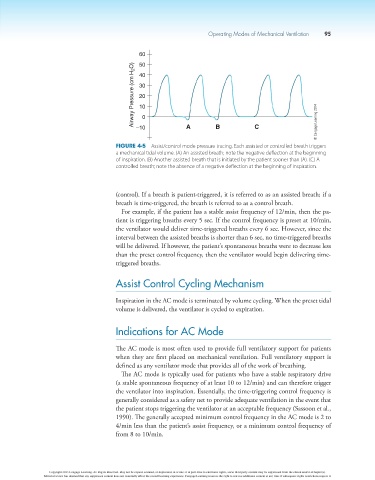
                                             Figure 4-5  Assist/control mode pressure tracing. Each assisted or controlled breath triggers
                                             a mechanical tidal volume. (A) An assisted breath; note the negative deflection at the beginning
                                             of inspiration. (B) Another assisted breath that is initiated by the patient sooner than (A). (C) A
                                             controlled breath; note the absence of a negative deflection at the beginning of inspiration.


                                             (control). If a breath is patient-triggered, it is referred to as an assisted breath; if a
                                             breath is time-triggered, the breath is referred to as a control breath.
                                               For example, if the patient has a stable assist frequency of 12/min, then the pa-
                                             tient is triggering breaths every 5 sec. If the control frequency is preset at 10/min,
                                             the ventilator would deliver time-triggered breaths every 6 sec. However, since the
                                             interval between the assisted breaths is shorter than 6 sec, no time-triggered breaths
                                             will be delivered. If however, the patient’s spontaneous breaths were to decrease less
                                             than the preset control frequency, then the ventilator would begin delivering time-
                                             triggered breaths.

                                             Assist Control Cycling Mechanism


                                             Inspiration in the AC mode is terminated by volume cycling. When the preset tidal
                                             volume is delivered, the ventilator is cycled to expiration.


                                             Indications for AC Mode


                                             The AC mode is most often used to provide full ventilatory support for patients
                                             when they are first placed on mechanical ventilation. Full ventilatory support is
                                             defined as any ventilator mode that provides all of the work of breathing.
                                               The AC mode is typically used for patients who have a stable respiratory drive
                                             (a stable spontaneous frequency of at least 10 to 12/min) and can therefore trigger
                                             the ventilator into inspiration. Essentially, the time-triggering control frequency is
                                             generally considered as a safety net to provide adequate ventilation in the event that
                                             the patient stops triggering the ventilator at an acceptable frequency (Sassoon et al.,
                                             1990). The generally accepted minimum control frequency in the AC mode is 2 to
                                             4/min less than the patient’s assist frequency, or a minimum control frequency of
                                             from 8 to 10/min.


                        Copyright 2013 Cengage Learning. All Rights Reserved. May not be copied, scanned, or duplicated, in whole or in part. Due to electronic rights, some third party content may be suppressed from the eBook and/or eChapter(s).
                      Editorial review has deemed that any suppressed content does not materially affect the overall learning experience. Cengage Learning reserves the right to remove additional content at any time if subsequent rights restrictions require it.

