


Page 128 - Clinical Application of Mechanical Ventilation
P. 128
94     Chapter 4


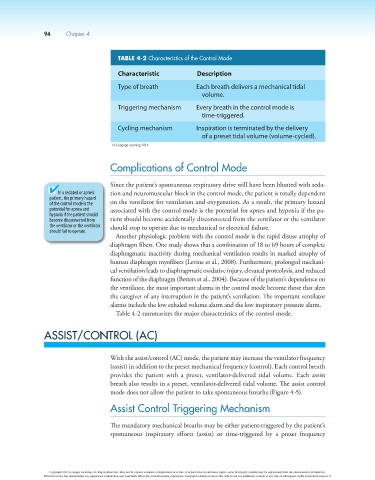
                                              TABLE 4-2 Characteristics of the Control Mode

                                              Characteristic            Description

                                              Type of breath            Each breath delivers a mechanical tidal
                                                                          volume.
                                              Triggering mechanism      Every breath in the control mode is
                                                                          time-triggered.

                                              Cycling mechanism         Inspiration is terminated by the delivery
                                                                         of a preset tidal volume (volume-cycled).
                                            © Cengage Learning 2014


                                            Complications of Control Mode


                                            Since the patient’s spontaneous respiratory drive will have been blunted with seda-
                          In a sedated or apneic   tion and neuromuscular block in the control mode, the patient is totally dependent
                        patient, the primary hazard
                        of the control mode is the   on the ventilator for ventilation and oxygenation. As a result, the primary hazard
                        potential for apnea and   associated with the control mode is the potential for apnea and hypoxia if the pa-
                        hypoxia if the patient should
                        become disconnected from   tient should become accidentally disconnected from the ventilator or the ventilator
                        the ventilator or the ventilator   should stop to operate due to mechanical or electrical failure.
                        should fail to operate.
                                             Another physiologic problem with the control mode is the rapid disuse atrophy of
                                            diaphragm fibers. One study shows that a combination of 18 to 69 hours of complete
                                            diaphragmatic inactivity during mechanical ventilation results in marked atrophy of
                                            human diaphragm myofibers (Levine et al., 2008). Furthermore, prolonged mechani-
                                            cal ventilation leads to diaphragmatic oxidative injury, elevated proteolysis, and reduced
                                            function of the diaphragm (Betters et al., 2004). Because of the patient’s dependence on
                                            the ventilator, the most important alarms in the control mode become those that alert
                                            the caregiver of any interruption in the patient’s ventilation. The important ventilator
                                            alarms include the low exhaled volume alarm and the low inspiratory pressure alarm.
                                             Table 4-2 summarizes the major characteristics of the control mode.


                      ASSIST/CONTROL (AC)


                                            With the assist/control (AC) mode, the patient may increase the ventilator frequency
                                            (assist) in addition to the preset mechanical frequency (control). Each control breath
                                            provides the patient with a preset, ventilator-delivered tidal volume. Each assist
                                            breath also results in a preset, ventilator-delivered tidal volume. The assist control
                                            mode does not allow the patient to take spontaneous breaths (Figure 4-5).

                                            Assist Control Triggering Mechanism


                                            The mandatory mechanical breaths may be either patient-triggered by the patient’s
                                            spontaneous  inspiratory  efforts  (assist)  or  time-triggered  by  a  preset  frequency


                        Copyright 2013 Cengage Learning. All Rights Reserved. May not be copied, scanned, or duplicated, in whole or in part. Due to electronic rights, some third party content may be suppressed from the eBook and/or eChapter(s).
                      Editorial review has deemed that any suppressed content does not materially affect the overall learning experience. Cengage Learning reserves the right to remove additional content at any time if subsequent rights restrictions require it.

