


Page 130 - Clinical Application of Mechanical Ventilation
P. 130
96     Chapter 4


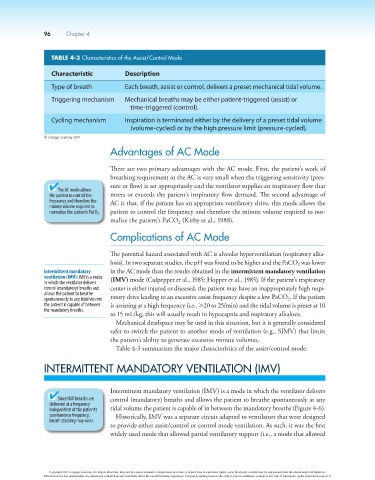
                        TABLE 4-3 Characteristics of the Assist/Control Mode

                        Characteristic          Description

                        Type of breath          Each breath, assist or control, delivers a preset mechanical tidal volume.

                        Triggering mechanism    Mechanical breaths may be either patient-triggered (assist) or
                                                  time-triggered (control).

                        Cycling mechanism       Inspiration is terminated either by the delivery of a preset tidal volume
                                                  (volume-cycled) or by the high pressure limit (pressure-cycled).
                      © Cengage Learning 2014
                                            Advantages of AC Mode


                                            There are two primary advantages with the AC mode. First, the patient’s work of
                                            breathing requirement in the AC is very small when the triggering sensitivity (pres-
                                            sure or flow) is set appropriately and the ventilator supplies an inspiratory flow that
                          The AC mode allows
                        the patient to control the   meets or exceeds the patient’s inspiratory flow demand. The second advantage of
                        frequency and therefore the   AC is that, if the patient has an appropriate ventilatory drive, this mode allows the
                        minute volume required to
                        normalize the patient’s PaCO 2 .  patient to control the frequency and therefore the minute volume required to nor-
                                            malize the patient’s PaCO  (Kirby et al., 1988).
                                                                  2
                                            Complications of AC Mode


                                            The potential hazard associated with AC is alveolar hyperventilation (respiratory alka-
                                            losis). In two separate studies, the pH was found to be higher and the PaCO  was lower
                                                                                                         2
                      intermittent mandatory   in the AC mode than the results obtained in the intermittent mandatory ventilation
                      ventilation (IMV): IMV is a mode   (IMV) mode (Culpepper et al., 1985; Hopper et al., 1985). If the patient’s respiratory
                      in which the ventilator delivers
                      control (mandatory) breaths and   center is either injured or diseased, the patient may have an inappropriately high respi-
                      allows the patient to breathe
                                                                                                     2
                      spontaneously to any tidal volume   ratory drive leading to an excessive assist frequency despite a low PaCO . If the patient
                      the patient is capable of between   is assisting at a high frequency (i.e., .20 to 25/min) and the tidal volume is preset at 10
                      the mandatory breaths.
                                            to 15 mL/kg, this will usually result in hypocapnia and respiratory alkalosis.
                                             Mechanical deadspace may be used in this situation, but it is generally considered
                                            safer to switch the patient to another mode of ventilation (e.g., SIMV) that limits
                                            the patient’s ability to generate excessive minute volumes.
                                             Table 4-3 summarizes the major characteristics of the assist/control mode.


                      INTERMITTENT MANDATORY VENTILATION (IMV)


                                            Intermittent mandatory ventilation (IMV) is a mode in which the ventilator delivers
                          Since IMV breaths are   control (mandatory) breaths and allows the patient to breathe spontaneously at any
                        delivered at a frequency
                        independent of the patient’s   tidal volume the patient is capable of in between the mandatory breaths (Figure 4-6).
                        spontaneous frequency,   Historically, IMV was a separate circuit adapted to ventilators that were designed
                        breath stacking may occur.
                                            to provide either assist/control or control mode ventilation. As such, it was the first
                                            widely used mode that allowed partial ventilatory support (i.e., a mode that allowed


                        Copyright 2013 Cengage Learning. All Rights Reserved. May not be copied, scanned, or duplicated, in whole or in part. Due to electronic rights, some third party content may be suppressed from the eBook and/or eChapter(s).
                      Editorial review has deemed that any suppressed content does not materially affect the overall learning experience. Cengage Learning reserves the right to remove additional content at any time if subsequent rights restrictions require it.

