


Page 197 - Clinical Application of Mechanical Ventilation
P. 197
Airway Management in Mechanical Ventilation  163


                                                                                                         © Cengage Learning 2014


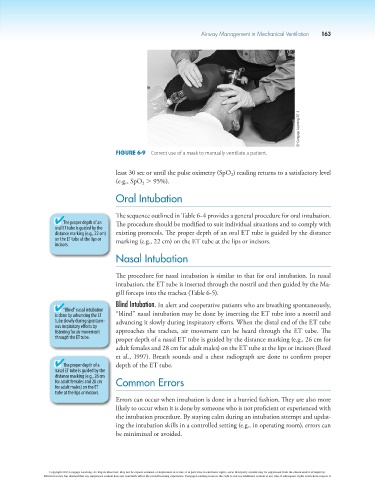
                                             Figure 6-9  Correct use of a mask to manually ventilate a patient.

                                             least 30 sec or until the pulse oximetry (SpO ) reading returns to a satisfactory level
                                                                                   2
                                             (e.g., SpO  . 95%).
                                                      2
                                             Oral Intubation


                                             The sequence outlined in Table 6-4 provides a general procedure for oral intubation.
                            The proper depth of an   The procedure should be modified to suit individual situations and to comply with
                          oral ET tube is guided by the
                          distance marking (e.g., 22 cm)   existing protocols. The proper depth of an oral ET tube is guided by the distance
                          on the ET tube at the lips or   marking (e.g., 22 cm) on the ET tube at the lips or incisors.
                          incisors.

                                             Nasal Intubation


                                             The procedure for nasal intubation is similar to that for oral intubation. In nasal
                                             intubation, the ET tube is inserted through the nostril and then guided by the Ma-
                                             gill forceps into the trachea (Table 6-5).

                                             Blind Intubation. In alert and cooperative patients who are breathing spontaneously,
                            “Blind” nasal intubation
                          is done by advancing the ET   “blind” nasal intubation may be done by inserting the ET tube into a nostril and
                          tube slowly during spontane-  advancing it slowly during inspiratory efforts. When the distal end of the ET tube
                          ous inspiratory efforts by
                          listening for air movement   approaches  the  trachea,  air  movement  can  be  heard  through  the  ET  tube.  The
                          through the ET tube.  proper depth of a nasal ET tube is guided by the distance marking (e.g., 26 cm for
                                             adult females and 28 cm for adult males) on the ET tube at the lips or incisors (Reed
                                             et al., 1997). Breath sounds and a chest radiograph are done to confirm proper
                            The proper depth of a   depth of the ET tube.
                          nasal ET tube is guided by the
                          distance marking (e.g., 26 cm
                          for adult females and 28 cm   Common Errors
                          for adult males) on the ET
                          tube at the lips or incisors.
                                             Errors can occur when intubation is done in a hurried fashion. They are also more
                                             likely to occur when it is done by someone who is not proficient or experienced with
                                             the intubation procedure. By staying calm during an intubation attempt and updat-
                                             ing the intubation skills in a controlled setting (e.g., in operating room), errors can
                                             be minimized or avoided.


                        Copyright 2013 Cengage Learning. All Rights Reserved. May not be copied, scanned, or duplicated, in whole or in part. Due to electronic rights, some third party content may be suppressed from the eBook and/or eChapter(s).
                      Editorial review has deemed that any suppressed content does not materially affect the overall learning experience. Cengage Learning reserves the right to remove additional content at any time if subsequent rights restrictions require it.

