


Page 196 - Clinical Application of Mechanical Ventilation
P. 196
162    Chapter 6


                                            devices for intubation, including the low-cost lighted stylet, flexible fiberoptic sty-
                                            lets, and video systems (Liem et al., 2003). When compared to direct laryngoscopy,
                                            the optical stylet has equivalent intubation time, less hemodynamic variability, less
                                            trauma and sore throat, and less failed intubation of difficulty airway. The optical
                                            stylet does not require new skills and is easy to learn. It also offers a faster setup than
                                            the traditional fiberoptic bronchoscope and a low acquisition and maintenance cost.
                                            (Gravenstein et al., 2004).


                                            Selection of Endotracheal Tube


                          Mentally count from 1   The size of an ET tube should be the largest one appropriate to a patient. Compared
                        to 30 when you begin the   to a smaller ET tube, a larger one offers lower airflow resistance, and lower (peak,
                        intubation attempt.
                                            plateau, mean) airway pressures. A larger ET tube also improves dynamic compli-
                                            ance and facilitates secretion removal.
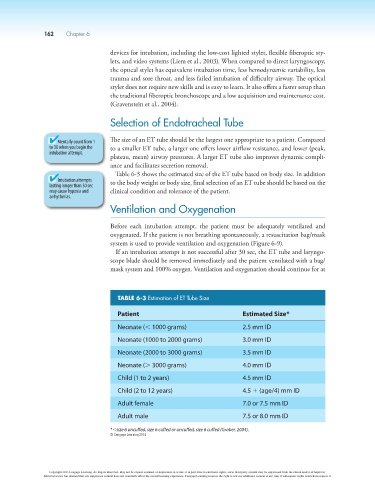
                                             Table 6-3 shows the estimated size of the ET tube based on body size. In addition
                          Intubation attempts   to the body weight or body size, final selection of an ET tube should be based on the
                        lasting longer than 30 sec
                        may cause hypoxia and    clinical condition and tolerance of the patient.
                        arrhythmias.
                                            Ventilation and Oxygenation


                                            Before  each  intubation  attempt,  the  patient  must  be  adequately  ventilated  and
                                            oxygenated. If the patient is not breathing spontaneously, a resuscitation bag/mask
                                            system is used to provide ventilation and oxygenation (Figure 6-9).
                                             If an intubation attempt is not successful after 30 sec, the ET tube and laryngo-
                                            scope blade should be removed immediately and the patient ventilated with a bag/
                                            mask system and 100% oxygen. Ventilation and oxygenation should continue for at


                                              TABLE 6-3 Estimation of ET Tube Size

                                              Patient                                  Estimated Size*

                                              Neonate (, 1000 grams)                   2.5 mm ID

                                              Neonate (1000 to 2000 grams)             3.0 mm ID
                                              Neonate (2000 to 3000 grams)             3.5 mm ID

                                              Neonate (. 3000 grams)                   4.0 mm ID
                                              Child (1 to 2 years)                     4.5 mm ID

                                              Child (2 to 12 years)                    4.5 1 (age/4) mm ID

                                              Adult female                             7.0 or 7.5 mm ID
                                              Adult male                               7.5 or 8.0 mm ID

                                            *,size 6 uncuffed, size 6 cuffed or uncuffed, size 6 cuffed (Graber, 2004).
                                            © Cengage Learning 2014


                        Copyright 2013 Cengage Learning. All Rights Reserved. May not be copied, scanned, or duplicated, in whole or in part. Due to electronic rights, some third party content may be suppressed from the eBook and/or eChapter(s).
                      Editorial review has deemed that any suppressed content does not materially affect the overall learning experience. Cengage Learning reserves the right to remove additional content at any time if subsequent rights restrictions require it.

