


Page 293 - Clinical Application of Mechanical Ventilation
P. 293
Monitoring in Mechanical Ventilation  259


                                             Accuracy and Clinical Use of Pulse Oximetry


                                             Pulse oximetry has been used as a reliable noninvasive means of monitoring oxy-
                                             genation in mechanically ventilated patient. SpO  of .95% has a strong correlation
                                                                                       2
                                             with PaO  of .70 mm Hg with a sensitivity of 100% (Niehoff et al., 1988).
                                                      2
                            SpO 2  above 92%   SpO  can be used to facilitate F O  weaning. The F O  may be reduced to an
                                                                           I
                                                   2
                                                                              2
                                                                                               2
                                                                                             I
                          correlates with a PaO 2  above   appropriate level by use of a single arterial blood gas measurement followed by
                          60 mm Hg.
                                             multiple pulse oximetry measurements (Rotello et al., 1992). Oxygenation of the
                                             ventilator-dependent patient can be assured when the SpO  is kept above 92% as
                                                                                                2
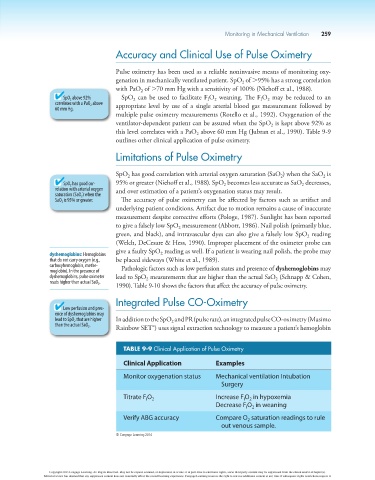
                                             this level correlates with a PaO  above 60 mm Hg (Jubran et al., 1990). Table 9-9
                                                                        2
                                             outlines other clinical application of pulse oximetry.
                                             Limitations of Pulse Oximetry
                                             SpO  has good correlation with arterial oxygen saturation (SaO ) when the SaO  is
                                                                                                   2
                                                                                                                 2
                                                 2
                            SpO 2  has good cor-  95% or greater (Niehoff et al., 1988). SpO  becomes less accurate as SaO  decreases,
                                                                                                          2
                                                                                 2
                          relation with arterial oxygen   and over estimation of a patient’s oxygenation status may result.
                          saturation (SaO 2 ) when the
                          SaO 2  is 95% or greater.  The accuracy of pulse oximetry can be affected by factors such as artifact and
                                             underlying patient conditions. Artifact due to motion remains a cause of inaccurate
                                             measurement despite corrective efforts (Pologe, 1987). Sunlight has been reported
                                             to give a falsely low SpO  measurement (Abbott, 1986). Nail polish (primarily blue,
                                                                  2
                                             green, and black), and intravascular dyes can also give a falsely low SpO  reading
                                                                                                            2
                                             (Welch, DeCesare & Hess, 1990). Improper placement of the oximeter probe can
                                             give a faulty SpO  reading as well. If a patient is wearing nail polish, the probe may
                        dyshemoglobins: Hemoglobins         2
                        that do not carry oxygen (e.g.,   be placed sideways (White et al., 1989).
                        carboxyhemoglobin, methe-  Pathologic factors such as low perfusion states and presence of dyshemoglobins may
                        moglobin). In the presence of
                        dyshemoglobins, pulse oximeter   lead to SpO  measurements that are higher than the actual SaO  (Schnapp & Cohen,
                                                       2
                                                                                                  2
                        reads higher than actual SaO 2 .
                                             1990). Table 9-10 shows the factors that affect the accuracy of pulse oximetry.
                                             Integrated Pulse CO-Oximetry
                            Low perfusion and pres-
                          ence of dyshemoglobins may
                          lead to SpO 2  that are higher   In addition to the SpO  and PR (pulse rate), an integrated pulse CO-oximetry (Masimo
                                                                2
                          than the actual SaO 2 .
                                             Rainbow SET®) uses signal extraction technology to measure a patient’s hemoglobin
                                                TABLE 9-9 Clinical Application of Pulse Oximetry

                                                Clinical Application          Examples

                                                Monitor oxygenation status    Mechanical ventilation Intubation
                                                                                Surgery
                                                Titrate F O 2                 Increase F O  in hypoxemia
                                                                                         2
                                                                                       I
                                                       I
                                                                              Decrease F O  in weaning
                                                                                        I
                                                                                          2
                                                Verify ABG accuracy           Compare O  saturation readings to rule
                                                                                        2
                                                                                out venous sample.
                                              © Cengage Learning 2014


                        Copyright 2013 Cengage Learning. All Rights Reserved. May not be copied, scanned, or duplicated, in whole or in part. Due to electronic rights, some third party content may be suppressed from the eBook and/or eChapter(s).
                      Editorial review has deemed that any suppressed content does not materially affect the overall learning experience. Cengage Learning reserves the right to remove additional content at any time if subsequent rights restrictions require it.

