


Page 292 - Clinical Application of Mechanical Ventilation
P. 292
258    Chapter 9


                                            Nevertheless, arterial blood gases can still provide very useful information when
                                            used  in  conjunction  with  other  monitoring  techniques  and  thorough  patient
                                            assessment.

                      OXYGEN SATURATION MONITORING


                                            Oxygen saturation is traditionally measured by arterial blood gases. The arterial
                                            oxygen saturation (SaO ) is not always readily available. A simple and noninvasive
                                                                2
                                            method to monitor the oxygen saturation is by using a pulse oximeter. The pulse
                      pulse oximeter: A device
                      that estimates arterial oxygen   oximetry oxygen saturation (SpO ) is less accurate than SaO  but it can provide
                                                                         2
                                                                                                 2
                      saturation (SpO 2 ) by emitting dual   quick spot checks or a trend reflecting a patient’s oxygenation status.
                      wavelengths of light through a
                      pulsating vascular bed.
                                            Pulse Oximetry
                                            Pulse oximetry has become perhaps the most frequently used method of assess-
                                            ing a patient’s oxygenation status. This noninvasive method measures the ap-
                                            proximate oxyhemoglobin saturation (SpO ). It is non invasive and easy to use.
                                                                                 2
                                            Pulse oximeters may be used intermittently to “spot check” the SpO  or continu-
                                                                                                       2
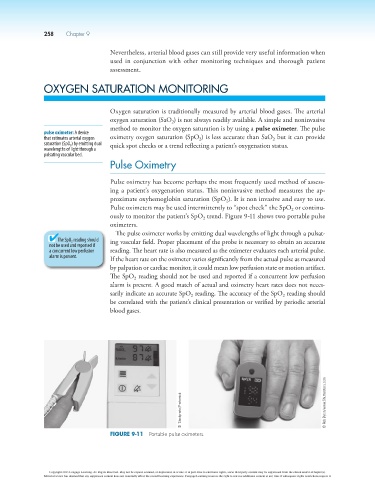
                                            ously to monitor the patient’s SpO  trend. Figure 9-11 shows two portable pulse
                                                                          2
                                            oximeters.
                                             The pulse oximeter works by emitting dual wavelengths of light through a pulsat-
                          The SpO 2  reading should   ing vascular field. Proper placement of the probe is necessary to obtain an accurate
                        not be used and reported if
                        a concurrent low perfusion   reading. The heart rate is also measured as the oximeter evaluates each arterial pulse.
                        alarm is present.   If the heart rate on the oximeter varies significantly from the actual pulse as measured
                                            by palpation or cardiac monitor, it could mean low perfusion state or motion artifact.
                                            The SpO  reading should not be used and reported if a concurrent low perfusion
                                                   2
                                            alarm is present. A good match of actual and oximetry heart rates does not neces-
                                            sarily indicate an accurate SpO  reading. The accuracy of the SpO  reading should
                                                                                                    2
                                                                      2
                                            be correlated with the patient’s clinical presentation or verified by periodic arterial
                                            blood gases.


                                                                   © iStockphoto/Photomick                        © Rob Byron/www.Shutterstock.com


                                            Figure 9-11  Portable pulse oximeters.


                        Copyright 2013 Cengage Learning. All Rights Reserved. May not be copied, scanned, or duplicated, in whole or in part. Due to electronic rights, some third party content may be suppressed from the eBook and/or eChapter(s).
                      Editorial review has deemed that any suppressed content does not materially affect the overall learning experience. Cengage Learning reserves the right to remove additional content at any time if subsequent rights restrictions require it.

