


Page 326 - Clinical Application of Mechanical Ventilation
P. 326
292    Chapter 10


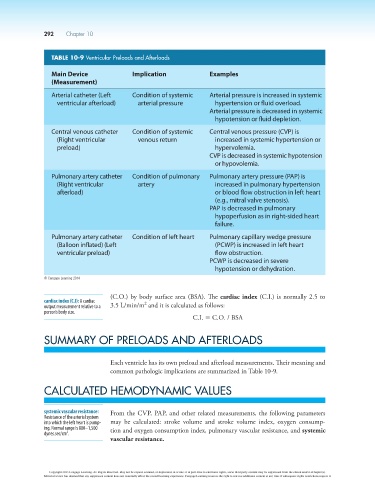
                        TABLE 10-9 Ventricular Preloads and Afterloads

                        Main Device                Implication              Examples
                        (Measurement)

                        Arterial catheter (Left    Condition of systemic    Arterial pressure is increased in systemic
                          ventricular afterload)     arterial pressure        hypertension or fluid overload.
                                                                            Arterial pressure is decreased in systemic
                                                                              hypotension or fluid depletion.
                        Central venous catheter    Condition of systemic    Central venous pressure (CVP) is
                          (Right ventricular         venous return            increased in systemic hypertension or
                          preload)                                            hypervolemia.
                                                                            CVP is decreased in systemic hypotension
                                                                              or hypovolemia.
                        Pulmonary artery catheter   Condition of pulmonary   Pulmonary artery pressure (PAP) is
                          (Right ventricular         artery                   increased in pulmonary hypertension
                          afterload)                                          or blood flow obstruction in left heart
                                                                              (e.g., mitral valve stenosis).
                                                                            PAP is decreased in pulmonary
                                                                              hypoperfusion as in right-sided heart
                                                                              failure.

                        Pulmonary artery catheter   Condition of left heart  Pulmonary capillary wedge pressure
                          (Balloon inflated) (Left                            (PCWP) is increased in left heart
                          ventricular preload)                                flow obstruction.
                                                                            PCWP is decreased in severe
                                                                              hypotension or dehydration.
                      © Cengage Learning 2014


                                            (C.O.) by body surface area (BSA). The cardiac index (C.I.) is normally 2.5 to
                      cardiac index (C.I): A cardiac   2
                      output measurement relative to a   3.5 L/min/m  and it is calculated as follows:
                      person’s body size.
                                                                       C.I. 5 C.O. / BSA


                      SUMMARY OF PRELOADS AND AFTERLOADS


                                            Each ventricle has its own preload and afterload measurements. Their meaning and
                                            common pathologic implications are summarized in Table 10-9.

                      CALCULATED HEMODYNAMIC VALUES


                      systemic vascular resistance:   From the CVP, PAP, and other related measurements, the following parameters
                      Resistance of the arterial system
                      into which the left heart is pump-  may  be  calculated:  stroke  volume  and  stroke  volume  index,  oxygen  consump-
                      ing. Normal range is 800–1,500   tion and oxygen consumption index, pulmonary vascular resistance, and systemic
                      dynes.sec/cm . 5
                                            vascular resistance.


                        Copyright 2013 Cengage Learning. All Rights Reserved. May not be copied, scanned, or duplicated, in whole or in part. Due to electronic rights, some third party content may be suppressed from the eBook and/or eChapter(s).
                      Editorial review has deemed that any suppressed content does not materially affect the overall learning experience. Cengage Learning reserves the right to remove additional content at any time if subsequent rights restrictions require it.

