


Page 323 - Clinical Application of Mechanical Ventilation
P. 323
Hemodynamic Monitoring  289


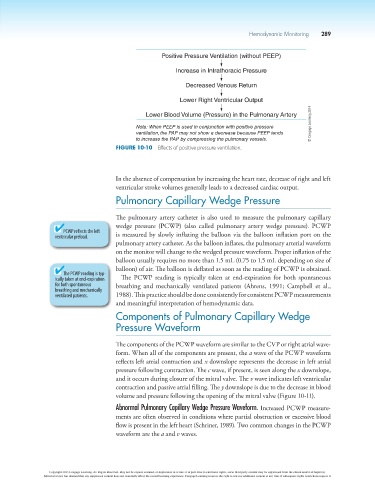
                                                            Positive Pressure Ventilation (without PEEP)

                                                                 Increase in Intrathoracic Pressure

                                                                    Decreased Venous Return

                                                                  Lower Right Ventricular Output

                                                       Lower Blood Volume (Pressure) in the Pulmonary Artery
                                                    Note: When PEEP is used in conjunction with positive pressure  © Cengage Learning 2014
                                                    ventilation, the PAP may not show a decrease because PEEP tends
                                                    to increase the PAP by compressing the pulmonary vessels.
                                             Figure 10-10  Effects of positive pressure ventilation.


                                             In the absence of compensation by increasing the heart rate, decrease of right and left
                                             ventricular stroke volumes generally leads to a decreased cardiac output.
                                             Pulmonary Capillary Wedge Pressure


                                             The pulmonary artery catheter is also used to measure the pulmonary capillary
                                             wedge  pressure  (PCWP)  (also  called  pulmonary  artery  wedge  pressure). PCWP
                            PCWP reflects the left
                          ventricular preload.  is measured by slowly inflating the balloon via the balloon inflation port on the
                                             pulmonary artery catheter. As the balloon inflates, the pulmonary arterial waveform
                                             on the monitor will change to the wedged pressure waveform. Proper inflation of the
                                             balloon usually requires no more than 1.5 mL (0.75 to 1.5 mL depending on size of
                                             balloon) of air. The balloon is deflated as soon as the reading of PCWP is obtained.
                            The PCWP reading is typ-
                          ically taken at end-expiration   The  PCWP  reading  is typically  taken  at  end-expiration for  both spontaneous
                          for both spontaneous   breathing  and  mechanically  ventilated  patients  (Ahrens,  1991;  Campbell  et  al.,
                          breathing and mechanically
                          ventilated patients.  1988). This practice should be done consistently for consistent PCWP measurements
                                             and meaningful interpretation of hemodynamic data.
                                             Components of Pulmonary Capillary Wedge

                                             Pressure Waveform


                                             The components of the PCWP waveform are similar to the CVP or right atrial wave-
                                             form. When all of the components are present, the a wave of the PCWP waveform
                                             reflects left atrial contraction and x downslope represents the decrease in left atrial
                                             pressure following contraction. The c wave, if present, is seen along the x downslope,
                                             and it occurs during closure of the mitral valve. The v wave indicates left ventricular
                                             contraction and passive atrial filling. The y downslope is due to the decrease in blood
                                             volume and pressure following the opening of the mitral valve (Figure 10-11).
                                             Abnormal Pulmonary Capillary Wedge Pressure Waveform. Increased PCWP measure-
                                             ments are often observed in conditions where partial obstruction or excessive blood
                                             flow is present in the left heart (Schriner, 1989). Two common changes in the PCWP
                                             waveform are the a and v waves.


                        Copyright 2013 Cengage Learning. All Rights Reserved. May not be copied, scanned, or duplicated, in whole or in part. Due to electronic rights, some third party content may be suppressed from the eBook and/or eChapter(s).
                      Editorial review has deemed that any suppressed content does not materially affect the overall learning experience. Cengage Learning reserves the right to remove additional content at any time if subsequent rights restrictions require it.

