


Page 322 - Clinical Application of Mechanical Ventilation
P. 322
288    Chapter 10


                                                                              B


                                                               A                      C
                                                                                               © Cengage Learning 2014


                                                                               Diastolic
                                                                    Systolic    Phase
                                                                     Phase
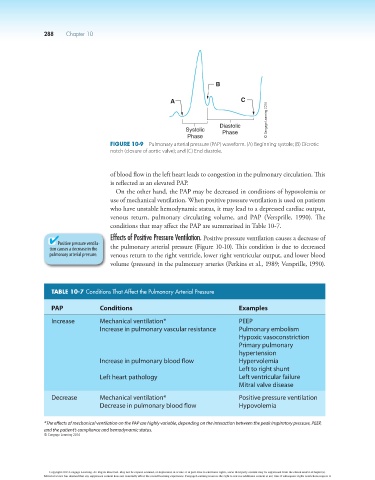
                                            Figure 10-9  Pulmonary arterial pressure (PAP) waveform. (A) Beginning systole; (B) Dicrotic
                                            notch (closure of aortic valve); and (C) End diastole.


                                            of blood flow in the left heart leads to congestion in the pulmonary circulation. This
                                            is reflected as an elevated PAP.
                                             On the other hand, the PAP may be decreased in conditions of hypovolemia or
                                            use of mechanical ventilation. When positive pressure ventilation is used on patients
                                            who have unstable hemodynamic status, it may lead to a depressed cardiac output,
                                            venous  return,  pulmonary  circulating  volume,  and  PAP  (Versprille,  1990).  The
                                            conditions that may affect the PAP are summarized in Table 10-7.

                                            Effects of Positive Pressure Ventilation. Positive pressure ventilation causes a decrease of
                          Positive pressure ventila-
                        tion causes a decrease in the   the pulmonary arterial pressure (Figure 10-10). This condition is due to decreased
                        pulmonary arterial pressure.  venous return to the right ventricle, lower right ventricular output, and lower blood
                                            volume (pressure) in the pulmonary arteries (Perkins et al., 1989; Versprille, 1990).


                        TABLE 10-7 Conditions That Affect the Pulmonary Arterial Pressure

                        PAP             Conditions                                    Examples

                        Increase        Mechanical ventilation*                       PEEP
                                        Increase in pulmonary vascular resistance     Pulmonary embolism
                                                                                      Hypoxic vasoconstriction
                                                                                      Primary pulmonary
                                                                                      hypertension
                                        Increase in pulmonary blood flow              Hypervolemia
                                                                                      Left to right shunt
                                        Left heart pathology                          Left ventricular failure
                                                                                      Mitral valve disease
                        Decrease        Mechanical ventilation*                       Positive pressure ventilation
                                        Decrease in pulmonary blood flow              Hypovolemia


                      *The effects of mechanical ventilation on the PAP are highly variable, depending on the interaction between the peak inspiratory pressure, PEEP,
                      and the patient’s compliance and hemodynamic status.
                      © Cengage Learning 2014


                        Copyright 2013 Cengage Learning. All Rights Reserved. May not be copied, scanned, or duplicated, in whole or in part. Due to electronic rights, some third party content may be suppressed from the eBook and/or eChapter(s).
                      Editorial review has deemed that any suppressed content does not materially affect the overall learning experience. Cengage Learning reserves the right to remove additional content at any time if subsequent rights restrictions require it.

