


Page 334 - Clinical Application of Mechanical Ventilation
P. 334
300    Chapter 10


                                            Accuracy of ICG


                                            Many studies have been done to compare and validate the accuracy of ICG with
                          The correlation of cardiac   other methods of hemodynamic monitoring (Drazner et al., 2002; Ziegler et al.,
                        output determined by ICG ver-
                        sus the Fick method and the   1999). In a study of patients with pulmonary arterial hypertension, the correlation of
                        thermodilution method were   cardiac output determined by ICG versus the Fick method and the thermodilution
                        0.84 and 0.80, respectively.
                                            method were 0.84 and 0.80, respectively (Yung et al., 2004). These correlation
                                            indices are similar to the results of other studies using different patient populations.
                                            Since ICG is less variable and more reproducible than other invasive methods, it has
                                            shown sufficient clinical usefulness to become a standard practice in noninvasive
                          Technical and measure-  hemodynamic evaluations (Van De Water et al., 2003).
                        ment errors of ICG include:
                        wrong placement of elec-  Methodology Errors. While ICG is useful in many clinical situations, there are some
                        trodes, abnormal body struc-
                        ture, tachycardia, presence   technical reasons and conditions that may influence the use and accuracy of ICG
                        of pacemaker, arrhythmias,
                        open-heart or aorta surgery,   (Braždžionytė et al., 2004a). They include wrong placement of electrodes; abnormal
                        abnormal cardiac anatomy,   body structure (cachetic or obese); tachycardia (.120/min); presence of pacemaker;
                        abnormal hematocrit, and
                        pleural effusion.   arrhythmias; open-heart or aorta surgery; abnormal cardiac anatomy (e.g., transpo-
                                            sitions, aneurysms); abnormal hematocrit; and pleural effusion.

                                            Clinical Application


                                            With ICG, the therapeutic effects of fluid administration and resuscitation can
                           ICG provides these    be assessed by monitoring the stroke volume and cardiac output. ICG has also
                        advantages: noninvasive
                        continuous monitoring, rapid   been used to evaluate the hemodynamic status of critically ill patients in the inten-
                        diagnosis and assessment of   sive care units, surgical areas, and outpatient and emergency departments (Bishop
                        cardiopulmonary status,
                        hemodynamic response to   et al., 1996; Milzman et al., 1997; Shoemaker et al., 1994; Wo et al., 1995; Yancey,
                        fluids and drugs, and availability   2003). Evaluation and follow-up of patients with acute myocardial infarction is also
                        outside the critical care area.
                                            possible with ICG (Braždžionytė et al., 2004b).
                                             In subacute care, adjustment of the dosages of cardiovascular drugs can be done
                                            by monitoring the thoracic fluid status, stroke volume, and cardiac output (Franz,
                                            1996). Since ICG monitoring is noninvasive, it can be used in outpatients as well as
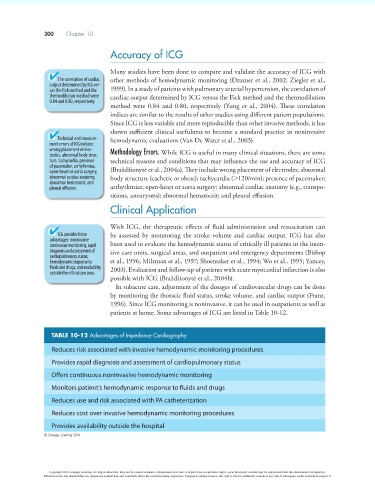
                                            patients at home. Some advantages of ICG are listed in Table 10-12.


                        TABLE 10-12 Advantages of Impedance Cardiography

                        Reduces risk associated with invasive hemodynamic monitoring procedures
                        Provides rapid diagnosis and assessment of cardiopulmonary status

                        Offers continuous noninvasive hemodynamic monitoring
                        Monitors patient’s hemodynamic response to fluids and drugs

                        Reduces use and risk associated with PA catheterization

                        Reduces cost over invasive hemodynamic monitoring procedures
                        Provides availability outside the hospital
                      © Cengage Learning 2014


                        Copyright 2013 Cengage Learning. All Rights Reserved. May not be copied, scanned, or duplicated, in whole or in part. Due to electronic rights, some third party content may be suppressed from the eBook and/or eChapter(s).
                      Editorial review has deemed that any suppressed content does not materially affect the overall learning experience. Cengage Learning reserves the right to remove additional content at any time if subsequent rights restrictions require it.

