


Page 421 - Clinical Application of Mechanical Ventilation
P. 421
Management of Mechanical Ventilation  387


                                             Respiratory Acidosis and Compensated
                                             Metabolic Alkalosis


                                             Respiratory	acidosis	(ventilatory	failure)	is	caused	by	hypoventilation.	The	strategy
                                             to	correct	this	abnormality	is	to	improve	ventilation.	For	specific	procedures	to
                                             improve	ventilation,	refer	to	the	section	on	“Strategies	to	Improve	Ventilation”	at
                                             the	beginning	of	this	chapter.
                                               The	strategies	to	improve	ventilation	are	useful	only	when	respiratory	acidosis	is
                            If a patient hypoven-  caused	by	hypoventilation.	These	strategies	should	not	be	used	when	hypoventila-
                          tilates to compensate for
                          metabolic alkalosis, increasing   tion	occurs	as	a	compensatory	mechanism	for	metabolic	alkalosis.	Compensated
                          ventilatory support will further   metabolic	alkalosis	has	an	elevated	PaCO ,	thus	mimicking	the	elevated	PaCO 	seen
                          compromise spontaneous                                2                              2
                          ventilation.       in	primary	or	compensated	respiratory	acidosis.
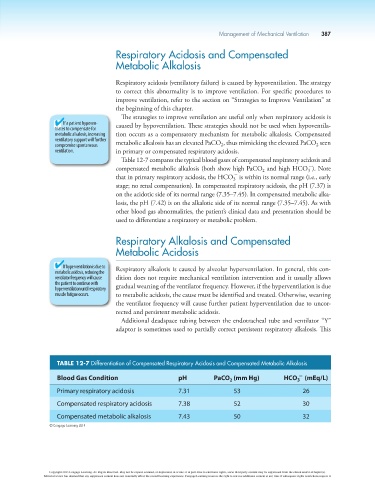
                                               Table	12-7	compares	the	typical	blood	gases	of	compensated	respiratory	acidosis	and
                                                                                                            	-
                                             compensated	metabolic	alkalosis	(both	show	high	PaCO 	and	high	HCO ).	Note
                                                                                                            3
                                                                                             2
                                                                                    	-
                                             that	in	primary	respiratory	acidosis,	the	HCO 	is	within	its	normal	range	(i.e.,	early
                                                                                    3
                                             stage;	no	renal	compensation).	In	compensated	respiratory	acidosis,	the	pH	(7.37)	is
                                             on	the	acidotic	side	of	its	normal	range	(7.35–7.45).	In	compensated	metabolic	alka-
                                             losis,	the	pH	(7.42)	is	on	the	alkalotic	side	of	its	normal	range	(7.35–7.45).	As	with
                                             other	blood	gas	abnormalities,	the	patient’s	clinical	data	and	presentation	should	be
                                             used	to	differentiate	a	respiratory	or	metabolic	problem.


                                             Respiratory Alkalosis and Compensated
                                             Metabolic Acidosis


                            If hyperventilation is due to   Respiratory	alkalosis	is	caused	by	alveolar	hyperventilation.	In	general,	this	con-
                          metabolic acidosis, reducing the
                          ventilator frequency will cause   dition	does	not	require	mechanical	ventilation	intervention	and	it	usually	allows
                          the patient to continue with   gradual	weaning	of	the	ventilator	frequency.	However,	if	the	hyperventilation	is	due
                          hyperventilation until respiratory
                          muscle fatigue occurs.  to	metabolic	acidosis,	the	cause	must	be	identified	and	treated.	Otherwise,	weaning
                                             the	ventilator	frequency	will	cause	further	patient	hyperventilation	due	to	uncor-
                                             rected	and	persistent	metabolic	acidosis.
                                               Additional	deadspace	tubing	between	the	endotracheal	tube	and	ventilator	“Y”
                                             adaptor	is	sometimes	used	to	partially	correct	persistent	respiratory	alkalosis.	This


                          TABLE 12-7  Differentiation of Compensated Respiratory Acidosis and Compensated Metabolic Alkalosis
                                                                                                          2
                          Blood Gas Condition                     pH         PaCO  (mm Hg)          HCO  (mEq/L)
                                                                                                         3
                                                                                   2
                          Primary respiratory acidosis            7.31              53                    26
                          Compensated respiratory acidosis        7.38              52                    30
                          Compensated metabolic alkalosis         7.43              50                    32
                        © Cengage Learning 2014


                        Copyright 2013 Cengage Learning. All Rights Reserved. May not be copied, scanned, or duplicated, in whole or in part. Due to electronic rights, some third party content may be suppressed from the eBook and/or eChapter(s).
                      Editorial review has deemed that any suppressed content does not materially affect the overall learning experience. Cengage Learning reserves the right to remove additional content at any time if subsequent rights restrictions require it.

