


Page 422 - Clinical Application of Mechanical Ventilation
P. 422
388    Chapter 12


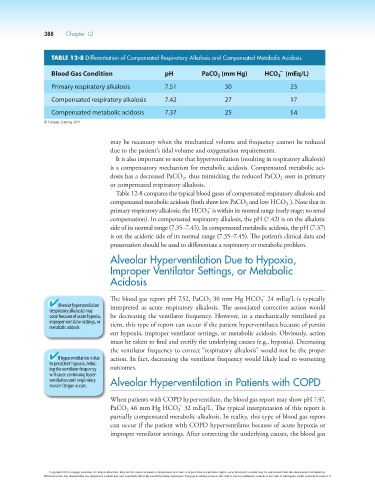
                        TABLE 12-8 Differentiation of Compensated Respiratory Alkalosis and Compensated Metabolic Acidosis

                                                                                                   2
                        Blood Gas Condition                  pH          PaCO  (mm Hg)        HCO  (mEq/L)
                                                                               2
                                                                                                  3
                        Primary respiratory alkalosis        7.51                30                   23
                        Compensated respiratory alkalosis    7.42                27                   17
                        Compensated metabolic acidosis       7.37                25                   14
                      © Cengage Learning 2014


                                            may	be	necessary	when	the	mechanical	volume	and	frequency	cannot	be	reduced
                                            due	to	the	patient’s	tidal	volume	and	oxygenation	requirements.
                                             It	is	also	important	to	note	that	hyperventilation	(resulting	in	respiratory	alkalosis)
                                            is	a	compensatory	mechanism	for	metabolic	acidosis.	Compensated	metabolic	aci-
                                            dosis	has	a	decreased	PaCO ,	thus	mimicking	the	reduced	PaCO 	seen	in	primary
                                                                   2
                                                                                                   2
                                            or	compensated	respiratory	alkalosis.
                                             Table	12-8	compares	the	typical	blood	gases	of	compensated	respiratory	alkalosis	and
                                                                                                     	-
                                            compensated	metabolic	acidosis	(both	show	low	PaCO 	and	low	HCO ).	Note	that	in
                                                                                        2
                                                                                                     3
                                                                           	-
                                            primary	respiratory	alkalosis,	the	HCO 	is	within	its	normal	range	(early	stage;	no	renal
                                                                           3
                                            compensation).	In	compensated	respiratory	alkalosis,	the	pH	(7.42)	is	on	the	alkalotic
                                            side	of	its	normal	range	(7.35–7.45).	In	compensated	metabolic	acidosis,	the	pH	(7.37)
                                            is	on	the	acidotic	side	of	its	normal	range	(7.35–7.45).	The	patient’s	clinical	data	and
                                            presentation	should	be	used	to	differentiate	a	respiratory	or	metabolic	problem.
                                            Alveolar Hyperventilation Due to Hypoxia,
                                            Improper Ventilator Settings, or Metabolic
                                            Acidosis


                                                                                             	-
                                            The	blood	gas	report	pH	7.52,	PaCO 	30	mm	Hg	HCO 	24	mEq/L	is	typically
                                                                                             3
                                                                            2
                          Alveolar hyperventilation   interpreted	 as	 acute	 respiratory	 alkalosis.	 The	 associated	 corrective	 action	 would
                        (respiratory alkalosis) may
                        occur because of acute hypoxia,   be	decreasing	the	ventilator	frequency.	However,	in	a	mechanically	ventilated	pa
                        improper ventilator settings, or   tient,	this	type	of	report	can	occur	if	the	patient	hyperventilates	because	of	persist
                        metabolic acidosis.
                                            ent	hypoxia,	improper	ventilator	settings,	or	metabolic	acidosis.	Obviously,	action
                                            must	be	taken	to	find	and	rectify	the	underlying	causes	(e.g.,	hypoxia).	Decreasing
                                            the	ventilator	frequency	to	correct	“respiratory	alkalosis”	would	not	be	the	proper
                          If hyperventilation is due   action.	In	fact,	decreasing	the	ventilator	frequency	would	likely	lead	to	worsening
                        to persistent hypoxia, reduc-
                        ing the ventilator frequency   outcomes.
                        will cause continuing hyper-
                        ventilation until respiratory   Alveolar Hyperventilation in Patients with COPD
                        muscle fatigue occurs.

                                            When	patients	with	COPD	hyperventilate,	the	blood	gas	report	may	show	pH	7.47,
                                                                  	-
                                            PaCO 	46	mm	Hg	HCO 	32	mEq/L.	The	typical	interpretation	of	this	report	is
                                                 2
                                                                  3
                                            partially	compensated	metabolic	alkalosis.	In	reality,	this	type	of	blood	gas	report
                                            can	occur	if	the	patient	with	COPD	hyperventilates	because	of	acute	hypoxia	or
                                            improper	ventilator	settings.	After	correcting	the	underlying	causes,	the	blood	gas


                        Copyright 2013 Cengage Learning. All Rights Reserved. May not be copied, scanned, or duplicated, in whole or in part. Due to electronic rights, some third party content may be suppressed from the eBook and/or eChapter(s).
                      Editorial review has deemed that any suppressed content does not materially affect the overall learning experience. Cengage Learning reserves the right to remove additional content at any time if subsequent rights restrictions require it.

