


Page 420 - Clinical Application of Mechanical Ventilation
P. 420
386    Chapter 12


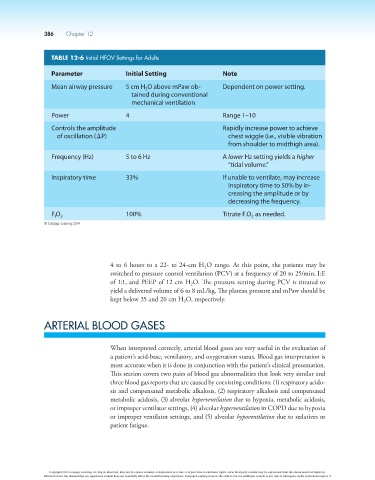
                        TABLE 12-6 Initial HFOV Settings for Adults

                        Parameter                Initial Setting                Note

                        Mean airway pressure     5 cm H O above mPaw ob-        Dependent on power setting.
                                                       2
                                                   tained during conventional
                                                   mechanical ventilation

                        Power                    4                              Range 1–10

                        Controls the amplitude                                  Rapidly increase power to achieve
                          of oscillation (DP)                                     chest wiggle (i.e., visible vibration
                                                                                  from shoulder to midthigh area).
                        Frequency (Hz)           5 to 6 Hz                      A lower Hz setting yields a higher
                                                                                  “tidal volume.”

                        Inspiratory time         33%                            If unable to ventilate, may increase
                                                                                  inspiratory time to 50% by in-
                                                                                  creasing the amplitude or by
                                                                                  decreasing the frequency.

                        F O 2                    100%                           Titrate F O  as needed.
                         I
                                                                                        I
                                                                                          2
                      © Cengage Learning 2014


                                            4	to	6	hours	to	a	22-	to	24-cm	H O	range.	At	this	point,	the	patients	may	be
                                                                          2
                                            switched	to	pressure	control	ventilation	(PCV)	at	a	frequency	of	20	to	25/min,	I:E
                                            of	1:1,	and	PEEP	of	12	cm	H O.	The	pressure	setting	during	PCV	is	titrated	to
                                                                      2
                                            yield	a	delivered	volume	of	6	to	8	mL/kg.	The	plateau	pressure	and	mPaw	should	be
                                            kept	below	35	and	20	cm	H O,	respectively.
                                                                    2


                      ARTERIAL BLOOD GASES


                                            When	interpreted	correctly,	arterial	blood	gases	are	very	useful	in	the	evaluation	of
                                            a	patient’s	acid-base,	ventilatory,	and	oxygenation	status.	Blood	gas	interpretation	is
                                            most	accurate	when	it	is	done	in	conjunction	with	the	patient’s	clinical	presentation.
                                            This	section	covers	two	pairs	of	blood	gas	abnormalities	that	look	very	similar	and
                                            three	blood	gas	reports	that	are	caused	by	coexisting	conditions:	(1)	respiratory	acido-
                                            sis	and	compensated	metabolic	alkalosis,	(2)	respiratory	alkalosis	and	compensated
                                            metabolic	acidosis,	(3)	alveolar	hyperventilation	due	to	hypoxia,	metabolic	acidosis,
                                            or	improper	ventilator	settings,	(4)	alveolar	hyperventilation	in	COPD	due	to	hypoxia
                                            or	improper	ventilator	settings,	and	(5)	alveolar	hypoventilation	due	to	sedatives	or
                                            patient	fatigue.


                        Copyright 2013 Cengage Learning. All Rights Reserved. May not be copied, scanned, or duplicated, in whole or in part. Due to electronic rights, some third party content may be suppressed from the eBook and/or eChapter(s).
                      Editorial review has deemed that any suppressed content does not materially affect the overall learning experience. Cengage Learning reserves the right to remove additional content at any time if subsequent rights restrictions require it.

