


Page 424 - Clinical Application of Mechanical Ventilation
P. 424
390    Chapter 12


                                            all	likelihood,	the	low	volume	alarm	will	also	be	triggered	since	pressure	and	volume
                          The low pressure   are	affected	simultaneously	by	similar	clinical	conditions.
                        alarm may be triggered in
                        (1) loss of circuit pressure   Conditions	that	may	trigger	the	low	pressure	alarm	may	be	grouped	into	four
                        (a common event), (2) loss of
                        system pressure (an uncommon   areas:	(1)	loss	of	circuit	pressure	(a	common	event),	(2)	loss	of	system	pressure
                        occurrence), (3) conditions lead-  (an	uncommon	occurrence),	(3)	conditions	leading	to	premature	termination	of
                        ing to premature termination
                        of inspiratory phase, and (4)   inspiratory	phase,	and	(4)	inappropriate	ventilator	settings.	These	conditions	and
                        inappropriate ventilator settings.  selected	examples	are	listed	in	Table	12-9.


                                            Low Expired Volume Alarm


                                            The	 low	 volume	 limit	 is	 set	 to	 ensure	 that	 the	 patient	 receives	 (and	 exhales)	 a
                                            minimum	volume.
                                             The	 low	 expired	 volume	 alarm	 is	 triggered	 when	 the	 expired	 volume	 drops
                                            below	the	preset	low	volume	limit.	If	the	preset	low	expired	volume	limit	is	set	at
                                            400	mL,	and	the	expired	volume	drops	below	400	mL,	the	low	volume	alarm	will
                          The low volume alarm   be	triggered.
                        is usually triggered along
                        with the low pressure alarm   As	mentioned	before,	the	low	volume	alarm	is	usually	triggered	along	with
                        because loss of airway pres-  the	low	pressure	alarm	because	loss	of	airway	pressure	usually	results	in	loss	of
                        sure usually results in loss of
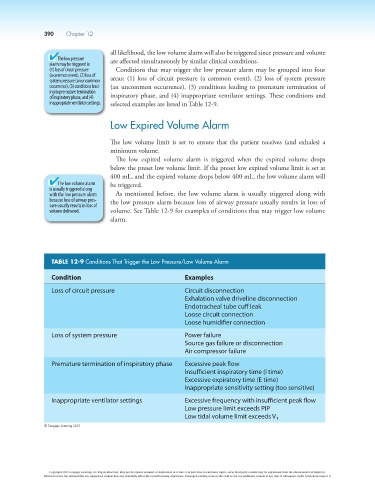
                        volume delivered.   volume.	See	Table	12-9	for	examples	of	conditions	that	may	trigger	low	volume
                                            alarm.


                        TABLE 12-9 Conditions That Trigger the Low Pressure/Low Volume Alarm

                        Condition                                   Examples

                        Loss of circuit pressure                    Circuit disconnection
                                                                    Exhalation valve driveline disconnection
                                                                    Endotracheal tube cuff leak
                                                                    Loose circuit connection
                                                                    Loose humidifier connection

                        Loss of system pressure                     Power failure
                                                                    Source gas failure or disconnection
                                                                    Air compressor failure

                        Premature termination of inspiratory phase  Excessive peak flow
                                                                    Insufficient inspiratory time (I time)
                                                                    Excessive expiratory time (E time)
                                                                    Inappropriate sensitivity setting (too sensitive)

                        Inappropriate ventilator settings           Excessive frequency with insufficient peak flow
                                                                    Low pressure limit exceeds PIP
                                                                    Low tidal volume limit exceeds V T
                      © Cengage Learning 2014


                        Copyright 2013 Cengage Learning. All Rights Reserved. May not be copied, scanned, or duplicated, in whole or in part. Due to electronic rights, some third party content may be suppressed from the eBook and/or eChapter(s).
                      Editorial review has deemed that any suppressed content does not materially affect the overall learning experience. Cengage Learning reserves the right to remove additional content at any time if subsequent rights restrictions require it.

