


Page 429 - Clinical Application of Mechanical Ventilation
P. 429
Management of Mechanical Ventilation  395


                                             Circuit Compliance


                                             The	compliance	of	ventilator	circuits	should	be	as	low	as	possible.	High	circuit	com-
                                             pliance	leads	to	a	higher	compressible	volume	in	the	circuit	during	inspiration,	and
                                             this	condition	reduces	the	effective	tidal	volume	delivered	to	the	patient.	For	example,
                                             at	a	peak	inspiratory	pressure	of	40	cm	H O,	a	ventilator	circuit	with	a	compliance
                                                                                 2
                                             of	5	mL/cm	H O	would	expand	and	hold	200	mL	(40	cm	H O	3	5	mL/cm	H O)
                                                          2
                                                                                                                 2
                                                                                                 2
                                             of	the	set	tidal	volume.	At	the	same	peak	inspiratory	pressure,	a	ventilator	circuit
                                             with	a	compliance	of	3	mL/cm	H O	would	have	a	compressible	volume	of	only
                                                                           2
                                             120	mL	(40	cm	H O	3	3	mL/cm	H O).	Unless	a	tidal	volume	adjustment	is	made
                                                                             2
                                                             2
                                             to	account	for	the	circuit	compliance	factor,	the	effective	(delivered)	tidal	volume	to
                                             the	patient	would	be	reduced	substantially	when	high	compliance	circuits	are	used
                                             (Burton	et	al.,	1997).
                                             Circuit Patency


                                             Condensation	imposes	the	most	common	threat	to	the	patency	of	ventilator	cir-
                                             cuits.	Gas	temperature	drops	as	it	travels	from	the	heated	humidifier	to	the	patient.
                                             As	the	temperature	drops	along	the	circuit,	water	vapor	condenses	and	water	col-
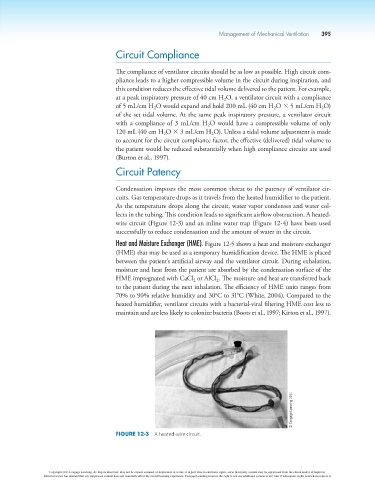
                                             lects	in	the	tubing.	This	condition	leads	to	significant	airflow	obstruction.	A	heated-
                                             wire	circuit	(Figure	12-3)	and	an	inline	water	trap	(Figure	12-4)	have	been	used
                                             successfully	to	reduce	condensation	and	the	amount	of	water	in	the	circuit.

                                             Heat and Moisture Exchanger (HME).	Figure	12-5	shows	a	heat	and	moisture	exchanger
                                             (HME)	that	may	be	used	as	a	temporary	humidification	device.	The	HME	is	placed
                                             between	the	patient’s	artificial	airway	and	the	ventilator	circuit.	During	exhalation,
                                             moisture	and	heat	from	the	patient	are	absorbed	by	the	condensation	surface	of	the
                                             HME	impregnated	with	CaCl 	or	AlCl .	The	moisture	and	heat	are	transferred	back
                                                                              2
                                                                       2
                                             to	the	patient	during	the	next	inhalation.	The	efficiency	of	HME	units	ranges	from
                                             70%	to	90%	relative	humidity	and	30°C	to	31°C	(White,	2004).	Compared	to	the
                                             heated	humidifier,	ventilator	circuits	with	a	bacterial-viral	filtering	HME	cost	less	to
                                             maintain	and	are	less	likely	to	colonize	bacteria	(Boots	et	al.,	1997;	Kirton	et	al.,	1997).


                                                                                                       © Cengage Learning 2014


                                             Figure 12-3  A heated-wire circuit.


                        Copyright 2013 Cengage Learning. All Rights Reserved. May not be copied, scanned, or duplicated, in whole or in part. Due to electronic rights, some third party content may be suppressed from the eBook and/or eChapter(s).
                      Editorial review has deemed that any suppressed content does not materially affect the overall learning experience. Cengage Learning reserves the right to remove additional content at any time if subsequent rights restrictions require it.

