


Page 432 - Clinical Application of Mechanical Ventilation
P. 432
398    Chapter 12


                                             Other	conditions	that	can	affect	the	patency	of	the	ET	tube	include	(1)	kinking
                                            or	bending	of	the	tube	due	to	poor	positioning	of	the	patient	and	placement	of	the
                                            ventilator	circuit;	(2)	patient	biting	on	the	ET	tube	due	to	physical	or	psychologic
                                            discomfort;	and	(3)	malfunction	of	the	ET	tube	cuff	causing	partial	or	complete
                                            blockage.
                                             Frequent	endotracheal	suctioning	is	sometimes	necessary	to	maintain	the	patency
                                            of	 the	 endotracheal	 tube.	 One	 of	 the	 problems	 with	 endotracheal	 suctioning	 is
                                            hypoxia.	Suction-induced	hypoxia	may	be	minimized	by	preoxygenating	the	pa-
                                            tient	prior	to	suction,	limiting	the	total	suction	time	to	no	more	than	10	sec,	and
                                            using	a	closed	inline	tracheal	suction	system	(Wilkins	et	al.,	2003).	Since	the	closed
                           Since the closed suction-  suctioning	system	allows	suctioning	without	disconnecting	the	ventilator	circuit,
                        ing system allows suctioning
                        without disconnecting the   F O 	and	PEEP	levels	may	be	maintained.	Closed	inline	suction	catheters	may	be
                                             I
                                               2
                        ventilator circuit, F I O 2  and PEEP   changed	weekly	(instead	of	daily)	with	no	significant	increase	in	the	frequency	of
                        levels may be maintained.
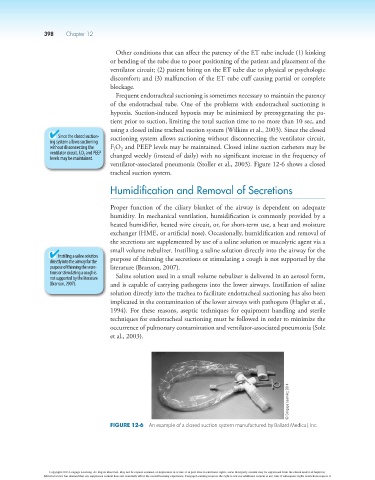
                                            ventilator-associated	pneumonia	(Stoller	et	al.,	2003).	Figure	12-6	shows	a	closed
                                            tracheal	suction	system.
                                            Humidification and Removal of Secretions


                                            Proper	 function	 of	 the	 ciliary	 blanket	 of	 the	 airway	 is	 dependent	 on	 adequate
                                            humidity.	In	mechanical	ventilation,	humidification	is	commonly	provided	by	a
                                            heated	humidifier,	heated	wire	circuit,	or,	for	short-term	use,	a	heat	and	moisture
                                            exchanger	(HME,	or	artificial	nose).	Occasionally,	humidification	and	removal	of
                                            the	secretions	are	supplemented	by	use	of	a	saline	solution	or	mucolytic	agent	via	a
                                            small	volume	nebulizer.	Instilling	a	saline	solution	directly	into	the	airway	for	the
                           Instilling a saline solution   purpose	of	thinning	the	secretions	or	stimulating	a	cough	is	not	supported	by	the
                        directly into the airway for the
                        purpose of thinning the secre-  literature	(Branson,	2007).
                        tions or stimulating a cough is
                        not supported by the literature   Saline	solution	used	in	a	small	volume	nebulizer	is	delivered	in	an	aerosol	form,
                        (Branson, 2007).    and	is	capable	of	carrying	pathogens	into	the	lower	airways.	Instillation	of	saline
                                            solution	directly	into	the	trachea	to	facilitate	endotracheal	suctioning	has	also	been
                                            implicated	in	the	contamination	of	the	lower	airways	with	pathogens	(Hagler	et	al.,
                                            1994).	For	these	reasons,	aseptic	techniques	for	equipment	handling	and	sterile
                                            techniques	for	endotracheal	suctioning	must	be	followed	in	order	to	minimize	the
                                            occurrence	of	pulmonary	contamination	and	ventilator-associated	pneumonia	(Sole
                                            et	al.,	2003).


                                                                                                      © Cengage Learning 2014


                                            Figure 12-6  An example of a closed suction system manufactured by Ballard Medical, Inc.


                        Copyright 2013 Cengage Learning. All Rights Reserved. May not be copied, scanned, or duplicated, in whole or in part. Due to electronic rights, some third party content may be suppressed from the eBook and/or eChapter(s).
                      Editorial review has deemed that any suppressed content does not materially affect the overall learning experience. Cengage Learning reserves the right to remove additional content at any time if subsequent rights restrictions require it.

