


Page 433 - Clinical Application of Mechanical Ventilation
P. 433
Management of Mechanical Ventilation  399


                                             Ventilator-Associated Pneumonia


                                             Patients	who	are	intubated	and	on	mechanical	ventilation	are	more	prone	to	de-
                                             velop	nosocomial	pneumonia	than	nonintubated	patients	(Craven	et	al.,	1989).	The
                                             estimated	incidence	of	ventilator-associated pneumonia	(VAP)	ranges	from	10%
                        ventilator-associated
                        pneumonia (VAP): Infection   to	65%,	with	fatality	rates	of	13%	to	55%	(Kollef	et	al.,	1994).	The	presence	of	an
                        of the lung parenchyma that is   artificial	airway	bypasses	the	natural	defense	mechanism	of	the	airway,	causes	local
                        related to any or multiple events
                        that the patient undergoes during   trauma	and	inflammation,	and	increases	the	risk	of	aspiration	of	pathogens	from
                        mechan ical ventilation.  the	oropharynx.
                                               In	one	study,	45%	of	the	patients	developed	pneumonia	within	3	days	of	intuba-
                                             tion	(Lowy	et	al.,	1987).	This	condition	may	be	caused	by	microbes	acquired	from
                                             the	patient’s	oropharynx,	respiratory	instruments,	health	care	providers	(Hu,	1991),
                                             endotracheal	and	nasogastric	tubes	(Joshi	et	al.,	1993),	and	manual	ventilation	bags
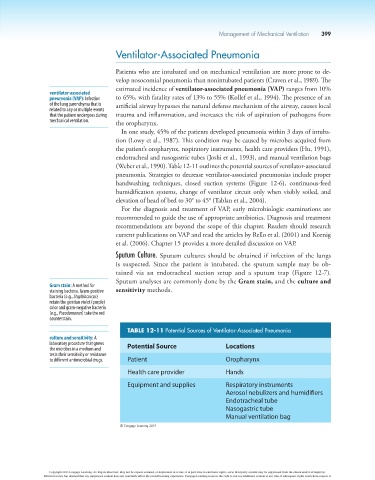
                                             (Weber	et	al.,	1990).	Table	12-11	outlines	the	potential	sources	of	ventilator-associated
                                             pneumonia.	Strategies	to	decrease	ventilator-associated	pneumonias	include	proper
                                             handwashing	 techniques,	 closed	 suction	 systems	 (Figure	 12-6),	 continuous-feed
                                             humidification	systems,	change	of	ventilator	circuit	only	when	visibly	soiled,	and
                                             elevation	of	head	of	bed	to	30°	to	45°	(Tablan	et	al.,	2004).
                                               For	the	diagnosis	and	treatment	of	VAP,	early	microbiologic	examinations	are
                                             recommended	to	guide	the	use	of	appropriate	antibiotics.	Diagnosis	and	treatment
                                             recommendations	are	beyond	the	scope	of	this	chapter.	Readers	should	research
                                             current	publications	on	VAP	and	read	the	articles	by	Rello	et	al.	(2001)	and	Koenig
                                             et	al.	(2006).	Chapter	15	provides	a	more	detailed	discussion	on	VAP.
                                             Sputum Culture.	Sputum	cultures	should	be	obtained	if	infection	of	the	lungs
                                             is	 suspected.	 Since	 the	 patient	 is	 intubated,	 the	 sputum	 sample	 may	 be	 ob-
                                             tained	 via	 an	 endotracheal	 suction	 setup	 and	 a	 sputum	 trap	 (Figure	 12-7).
                                             Sputum	analyses	are	commonly	done	by	the	Gram stain,	and	the	culture and
                        Gram stain: A method for
                        staining bacteria. Gram- positive   sensitivity methods.
                        bacteria (e.g., Staphlococcus)
                        retain the gentian violet (purple)
                        color and gram-negative bacteria
                        (e.g., Pseudomonas) take the red
                        counterstain.

                                                 TABLE 12-11 Potential Sources of Ventilator-Associated Pneumonia
                        culture and sensitivity: A
                        laboratory procedure that grows   Potential Source       Locations
                        the microbes in a medium and
                        tests their sensitivity or resistance
                        to different antimicrobial drugs.  Patient               Oropharynx
                                                 Health care provider            Hands

                                                 Equipment and supplies          Respiratory instruments
                                                                                 Aerosol nebulizers and humidifiers
                                                                                 Endotracheal tube
                                                                                 Nasogastric tube
                                                                                 Manual ventilation bag
                                               © Cengage Learning 2014


                        Copyright 2013 Cengage Learning. All Rights Reserved. May not be copied, scanned, or duplicated, in whole or in part. Due to electronic rights, some third party content may be suppressed from the eBook and/or eChapter(s).
                      Editorial review has deemed that any suppressed content does not materially affect the overall learning experience. Cengage Learning reserves the right to remove additional content at any time if subsequent rights restrictions require it.

