


Page 435 - Clinical Application of Mechanical Ventilation
P. 435
Management of Mechanical Ventilation  401


                                             TABLE 12-12 Distribution of Body Water

                                             Compartment      Subdivision       Percent of Water by Body Weight

                                             Extracellular    Plasma              5%

                                                              Interstitial fluid  15%
                                             Intracellular    Intracellular fluid  40%

                                             Total                              60% of body weight
                                           © Cengage Learning 2014


                                               Fluid	deficiency	in	the	extracellular	compartment	(space)	may	be	caused	by	one	or	a
                                             combination	of	these	reasons:	(1)	inadequate	intake	(e.g.,	dehydration);	(2)	excessive
                                             loss	(e.g.,	diarrhea);	and	(3)	shifting	of	fluid	along	with	the	electrolytes	into	cells	and
                                             tissues	(e.g.,	swelling	of	tissues	in	burns).

                                             Clinical Signs of Extracellular Fluid
                                             Deficit or Excess


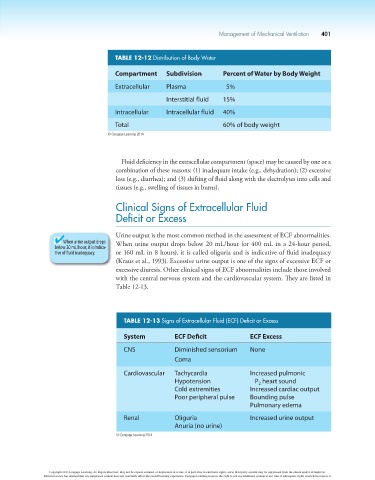
                                             Urine	output	is	the	most	common	method	in	the	assessment	of	ECF	abnormalities.
                            When urine output drops   When	urine	output	drops	below	20	mL/hour	(or	400	mL	in	a	24-hour	period,
                          below 20 mL/hour, it is indica-
                          tive of fluid inadequacy.  or	160	mL	in	8	hours),	it	is	called	oliguria	and	is	indicative	of	fluid	inadequacy
                                             (Kraus	et	al.,	1993).	Excessive	urine	output	is	one	of	the	signs	of	excessive	ECF	or
                                             excessive	diuresis.	Other	clinical	signs	of	ECF	abnormalities	include	those	involved
                                             with	the	central	nervous	system	and	the	cardiovascular	system.	They	are	listed	in
                                             Table	12-13.


                                                TABLE 12-13 Signs of Extracellular Fluid (ECF) Deficit or Excess

                                                System           ECF Deficit             ECF Excess

                                                CNS              Diminished sensorium    None
                                                                 Coma
                                                Cardiovascular   Tachycardia             Increased pulmonic
                                                                 Hypotension               P  heart sound
                                                                                            2
                                                                 Cold extremities        Increased cardiac output
                                                                 Poor peripheral pulse   Bounding pulse
                                                                                         Pulmonary edema
                                                Renal            Oliguria                Increased urine output
                                                                 Anuria (no urine)
                                              © Cengage Learning 2014


                        Copyright 2013 Cengage Learning. All Rights Reserved. May not be copied, scanned, or duplicated, in whole or in part. Due to electronic rights, some third party content may be suppressed from the eBook and/or eChapter(s).
                      Editorial review has deemed that any suppressed content does not materially affect the overall learning experience. Cengage Learning reserves the right to remove additional content at any time if subsequent rights restrictions require it.

