


Page 434 - Clinical Application of Mechanical Ventilation
P. 434
400    Chapter 12


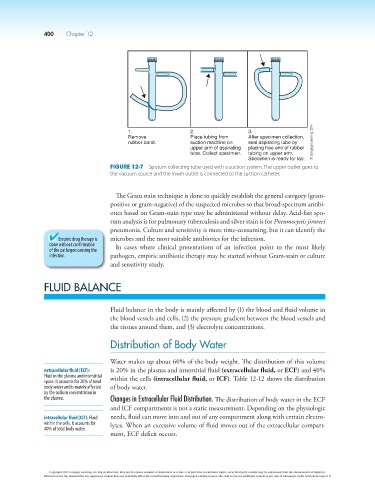
                                                 1.                   2.                 3.
                                                 Remove               Place tubing from  After specimen collection,
                                                 rubber band.         suction machine on  seal aspirating tube by  © Cengage Learning 2014
                                                                      upper arm of aspirating  placing free end of rubber
                                                                      tube. Collect specimen.  tubing on upper arm.
                                                                                         Specimen is ready for lab.
                                            Figure 12-7  Sputum collecting tube used with a suction system. The upper outlet goes to
                                            the vacuum source and the lower outlet is connected to the suction catheter.


                                             The	Gram	stain	technique	is	done	to	quickly	establish	the	general	category	(gram-
                                            positive	or	gram-negative)	of	the	suspected	microbes	so	that	broad-spectrum	antibi-
                                            otics	based	on	Gram-stain	type	may	be	administered	without	delay.	Acid-fast	spu-
                                            tum	analysis	is	for	pulmonary	tuberculosis	and	silver	stain	is	for	Pneumocystis	jiroveci
                                            pneumonia.	Culture	and	sensitivity	is	more	time-consuming,	but	it	can	identify	the
                           Empiric drug therapy is   microbes	and	the	most	suitable	antibiotics	for	the	infection.
                        done without confirmation   In	 cases	 where	 clinical	 presentations	 of	 an	 infection	 point	 to	 the	 most	 likely
                        of the pathogen causing the
                        infection.          pathogen,	empiric	antibiotic	therapy	may	be	started	without	Gram-stain	or	culture
                                            and	sensitivity	study.


                      FLUID BALANCE


                                            Fluid	balance	in	the	body	is	mainly	affected	by	(1)	the	blood	and	fluid	volume	in
                                            the	blood	vessels	and	cells,	(2)	the	pressure	gradient	between	the	blood	vessels	and
                                            the	tissues	around	them,	and	(3)	electrolyte	concentrations.

                                            Distribution of Body Water


                                            Water	makes	up	about	60%	of	the	body	weight.	The	distribution	of	this	volume
                      extracellular fluid (ECF):   is	20%	in	the	plasma	and	interstitial	fluid	(extracellular fluid,	or	ECF)	and	40%
                      Fluid in the plasma and interstitial   within	the	cells	(intracellular	fluid,	or	ICF).	Table	12-12	shows	the	distribution
                      space. It accounts for 20% of total
                      body water and is mainly affected   of	body	water.
                      by the sodium concentration in
                      the plasma.           Changes in Extracellular Fluid Distribution.	The	distribution	of	body	water	in	the	ECF
                                            and	ICF	compartments	is	not	a	static	measurement.	Depending	on	the	physiologic

                      intracellular fluid (ICF): Fluid   needs,	fluid	can	move	into	and	out	of	any	compartment	along	with	certain	electro-
                      within the cells. It accounts for   lytes.	When	an	excessive	volume	of	fluid	moves	out	of	the	extracellular	compart-
                      40% of total body water.
                                            ment,	ECF	deficit	occurs.


                        Copyright 2013 Cengage Learning. All Rights Reserved. May not be copied, scanned, or duplicated, in whole or in part. Due to electronic rights, some third party content may be suppressed from the eBook and/or eChapter(s).
                      Editorial review has deemed that any suppressed content does not materially affect the overall learning experience. Cengage Learning reserves the right to remove additional content at any time if subsequent rights restrictions require it.

