


Page 438 - Clinical Application of Mechanical Ventilation
P. 438
404    Chapter 12


                                            Hyponatremia.	Hyponatremia	is	a	more	common	form	of	sodium	abnormality	than
                          Hyponatremia is com-
                        monly related to ECF deficits   hypernatremia.	It	is	commonly	related	to	ECF	deficit	(hypovolemia).	The	usual
                        (hypovolemia). The usual   treatment	is	replenishment	of	sodium	with	saline	solution	(100	to	300	mL	of	2.5%
                        treatment is replenishment of
                        sodium with saline solution.  or	3%	saline).	It	is	not	safe	to	administer	fluids	that	have	no	sodium	because	water
                                            intoxication	may	occur.	Rapid	movement	of	sodium-free	fluid	into	the	brain	cells
                                            and	kidney	cells	by	the	action	of	osmosis	may	cause	edema	and	shutdown	of	these
                                            organs	(Eggleston,	1985).
                                            Hypernatremia.	Hypernatremia	is	an	uncommon	problem	in	the	clinical	setting.
                          Hypernatremia is an
                        uncommon problem and it   When	hypernatremia	occurs,	it	is	usually	related	to	water	deficit	as	a	result	of	pro-
                        is usually related to water   longed	intravenous	fluid	administration	with	sufficient	sodium	but	no	dextrose.
                        deficit as a result of prolonged
                        intravenous fluid administra-  This	condition	is	readily	reversible	by	a	water	solution	supplemented	with	dextrose
                        tion with sufficient sodium   (Eggleston,	1985).
                        but no dextrose.
                                            Potassium Abnormalities


                                            Potassium	is	the	major	cation	in	the	intracellular	fluid	(ICF),	therefore	it	has	a	nar-
                                            row	normal	range	(3–5	mEq/L)	outside	the	cells.	The	potassium	concentration	in
                                            the	ECF	may	be	higher	than	normal	(hyperkalemia)	or	lower	than	normal	(hypo-
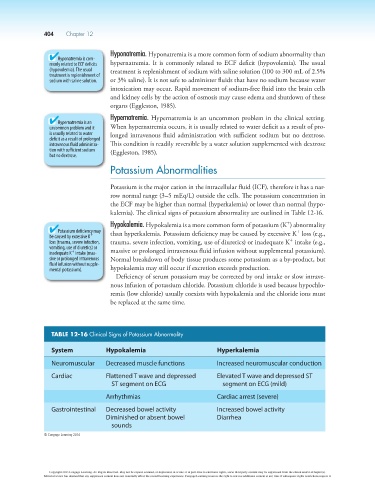
                                            kalemia).	The	clinical	signs	of	potassium	abnormality	are	outlined	in	Table	12-16.
                                                                                                     1
                                            Hypokalemia.	Hypokalemia	is	a	more	common	form	of	potassium	(K )	abnormality
                          Potassium deficiency may   than	hyperkalemia.	Potassium	deficiency	may	be	caused	by	excessive	K 	loss	(e.g.,
                                                                                                        1
                                     1
                        be caused by excessive K
                                                                                                      1
                        loss (trauma, severe infection,   trauma,	severe	infection,	vomiting,	use	of	diuretics)	or	inadequate	K 	intake	(e.g.,
                        vomiting, use of diuretics) or   massive	or	prolonged	intravenous	fluid	infusion	without	supplemental	potassium).
                               1
                        inadequate K  intake (mas-
                        sive or prolonged intravenous   Normal	breakdown	of	body	tissue	produces	some	potassium	as	a	by-product,	but
                        fluid infusion without supple-
                        mental potassium).  hypokalemia	may	still	occur	if	excretion	exceeds	production.
                                             Deficiency	of	serum	potassium	may	be	corrected	by	oral	intake	or	slow	intrave-
                                            nous	infusion	of	potassium	chloride.	Potassium	chloride	is	used	because	hypochlo-
                                            remia	(low	chloride)	usually	coexists	with	hypokalemia	and	the	chloride	ions	must
                                            be	replaced	at	the	same	time.


                        TABLE 12-16 Clinical Signs of Potassium Abnormality

                        System            Hypokalemia                         Hyperkalemia
                        Neuromuscular     Decreased muscle functions          Increased neuromuscular conduction

                        Cardiac           Flattened T wave and depressed      Elevated T wave and depressed ST
                                            ST segment on ECG                   segment on ECG (mild)
                                          Arrhythmias                         Cardiac arrest (severe)

                        Gastrointestinal  Decreased bowel activity            Increased bowel activity
                                          Diminished or absent bowel          Diarrhea
                                            sounds
                      © Cengage Learning 2014


                        Copyright 2013 Cengage Learning. All Rights Reserved. May not be copied, scanned, or duplicated, in whole or in part. Due to electronic rights, some third party content may be suppressed from the eBook and/or eChapter(s).
                      Editorial review has deemed that any suppressed content does not materially affect the overall learning experience. Cengage Learning reserves the right to remove additional content at any time if subsequent rights restrictions require it.

