


Page 466 - Clinical Application of Mechanical Ventilation
P. 466
432    Chapter 13


                                             Since serious adverse effects can occur with the use of these agents, they should
                                            not be given routinely or before alternative management is considered. If paralysis is
                                            indicated, a sedative drug, such as the benzodiazepines along with an opioid analgesic,
                                            should be provided for patient comfort. This is necessary because perception and pain
                                            thresholds of a patient still exist with use of neuromuscular blocking drugs.
                                             The following testimonies affirm the need for adequate sedation and analgesia
                                            during paralysis. One patient who was pharmacologically paralyzed but not sedated
                                            described his experience as “a feeling of being buried alive.” Another patient thought
                                            that she had died (Halloran, 1991). A trauma survivor recalls the sensation of en-
                                            dotracheal tube suctioning being like that of a red-hot burning iron passed into the
                                            trachea (Hansen-Flaschen et al., 1993).

                                            Mechanism of Action

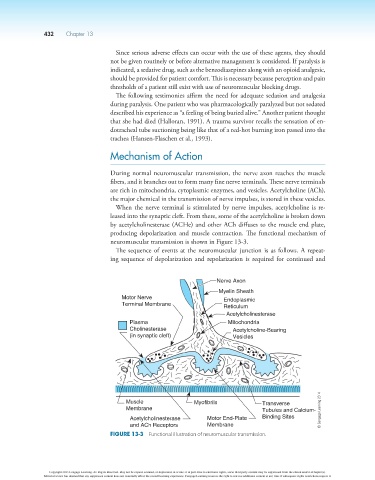
                                            During normal neuromuscular transmission, the nerve axon reaches the muscle
                                            fibers, and it branches out to form many fine nerve terminals. These nerve terminals
                                            are rich in mitochondria, cytoplasmic enzymes, and vesicles. Acetylcholine (ACh),
                                            the major chemical in the transmission of nerve impulses, is stored in these vesicles.
                                             When the nerve terminal is stimulated by nerve impulses, acetylcholine is re-
                                            leased into the synaptic cleft. From there, some of the acetylcholine is broken down
                                            by acetylcholinesterase (ACHe) and other ACh diffuses to the muscle end plate,
                                            producing depolarization and muscle contraction. The functional mechanism of
                                            neuromuscular transmission is shown in Figure 13-3.
                                             The sequence of events at the neuromuscular junction is as follows. A repeat-
                                            ing sequence of depolarization and repolarization is required for continued and


                                                                              Nerve Axon
                                                                               Myelin Sheath
                                               Motor Nerve                       Endoplasmic
                                               Terminal Membrane                 Reticulum

                                                                                 Acetylcholinesterase
                                                  Plasma                          Mitochondria
                                                  Cholinesterase                    Acetylcholine-Bearing
                                                  (in synaptic cleft)               Vesicles


                                                 Muscle                Myofibrils            Transverse
                                                 Membrane                                    Tubules and Calcium- © Cengage Learning 2014
                                                  Acetylcholinesterase     Motor End-Plate   Binding Sites
                                                  and ACh Receptors        Membrane
                                            Figure 13-3  Functional illustration of neuromuscular transmission.


                        Copyright 2013 Cengage Learning. All Rights Reserved. May not be copied, scanned, or duplicated, in whole or in part. Due to electronic rights, some third party content may be suppressed from the eBook and/or eChapter(s).
                      Editorial review has deemed that any suppressed content does not materially affect the overall learning experience. Cengage Learning reserves the right to remove additional content at any time if subsequent rights restrictions require it.

