


Page 468 - Clinical Application of Mechanical Ventilation
P. 468
434    Chapter 13


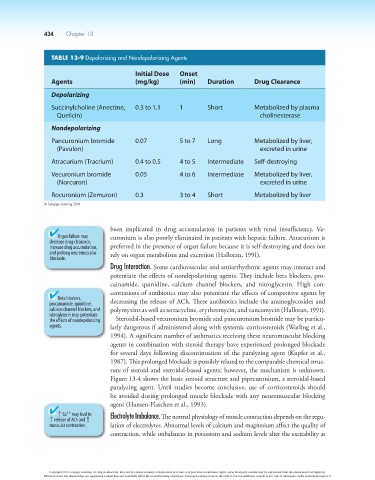
                        TABLE 13-9 Depolarizing and Nondepolarizing Agents

                                                    Initial Dose   Onset
                        Agents                      (mg/kg)       (min)    Duration        Drug Clearance

                        Depolarizing
                        Succinylcholine (Anectine,   0.3 to 1.1   1        Short           Metabolized by plasma
                          Quelicin)                                                         cholinesterase

                        Nondepolarizing
                        Pancuronium bromide         0.07          5 to 7   Long            Metabolized by liver,
                          (Pavulon)                                                         excreted in urine
                        Atracurium (Tracrium)       0.4 to 0.5    4 to 5   Intermediate    Self-destroying

                        Vecuronium bromide          0.05          4 to 6   Intermediate    Metabolized by liver,
                          (Norcuron)                                                        excreted in urine

                        Rocuronium (Zemuron)        0.3           3 to 4   Short           Metabolized by liver
                      © Cengage Learning 2014


                                            been  implicated  in  drug  accumulation  in  patients  with  renal  insufficiency.  Ve-
                           Organ failure may   curonium is also poorly eliminated in patients with hepatic failure. Atracurium is
                        decrease drug clearance,
                        increase drug accumulation,   preferred in the presence of organ failure because it is self-destroying and does not
                        and prolong neuromuscular   rely on organ metabolism and excretion (Halloran, 1991).
                        blockade.
                                            Drug Interaction. Some cardiovascular and antiarrhythmic agents may interact and
                                            potentiate the effects of nondepolarizing agents. They include beta blockers, pro-
                                            cainamide,  quinidine,  calcium  channel  blockers,  and  nitroglycerin.  High  con-
                                            centrations of antibiotics may also potentiate the effects of competitive agents by
                          Beta blockers,
                        procainamide, quinidine,   decreasing the release of ACh. These antibiotics include the aminoglycosides and
                        calcium channel blockers, and   polymyxins as well as tetracycline, erythromycin, and vancomycin (Halloran, 1991).
                        nitroglycerin may potentiate
                        the effects of nondepolarizing   Steroidal-based vecuronium bromide and pancuronium bromide may be particu-
                        agents.             larly dangerous if administered along with systemic corticosteroids (Watling et al.,
                                            1994). A significant number of asthmatics receiving these neuromuscular blocking
                                            agents in combination with steroid therapy have experienced prolonged blockade
                                            for several days following discontinuation of the paralyzing agent (Kupfer et al.,
                                            1987). This prolonged blockade is possibly related to the comparable chemical struc-
                                            ture of steroid and steroidal-based agents; however, the mechanism is unknown.
                                            Figure 13-4 shows the basic steroid structure and pipecuronium, a steroidal-based
                                            paralyzing agent. Until studies become conclusive, use of corticosteroids should
                                            be avoided during prolonged muscle blockade with any neuromuscular blocking
                                            agent (Hansen-Flaschen et al., 1993).
                           c Ca  may lead to   Electrolyte Imbalance. The normal physiology of muscle contraction depends on the regu-
                             ++
                        c release of ACh and c
                        muscular contraction.  lation of electrolytes. Abnormal levels of calcium and magnesium affect the quality of
                                            contraction, while imbalances in potassium and sodium levels alter the excitability at


                        Copyright 2013 Cengage Learning. All Rights Reserved. May not be copied, scanned, or duplicated, in whole or in part. Due to electronic rights, some third party content may be suppressed from the eBook and/or eChapter(s).
                      Editorial review has deemed that any suppressed content does not materially affect the overall learning experience. Cengage Learning reserves the right to remove additional content at any time if subsequent rights restrictions require it.

