


Page 471 - Clinical Application of Mechanical Ventilation
P. 471
Pharmacotherapy for Mechanical Ventilation  437


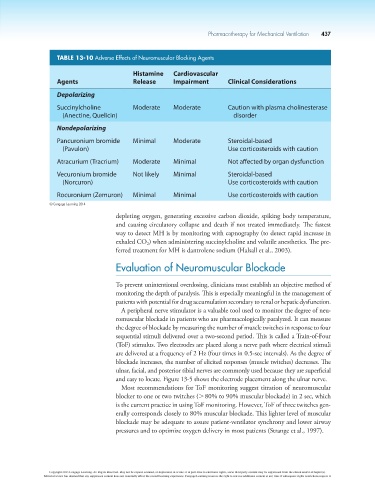
                          TABLE 13-10 Adverse Effects of Neuromuscular Blocking Agents

                                                   Histamine    Cardiovascular
                          Agents                   Release      Impairment        Clinical Considerations

                          Depolarizing
                          Succinylcholine          Moderate     Moderate          Caution with plasma cholinesterase
                            (Anectine, Quelicin)                                    disorder

                          Nondepolarizing
                          Pancuronium bromide      Minimal      Moderate          Steroidal-based
                            (Pavulon)                                             Use corticosteroids with caution
                          Atracurium (Tracrium)    Moderate     Minimal           Not affected by organ dysfunction

                          Vecuronium bromide       Not likely   Minimal           Steroidal-based
                            (Norcuron)                                            Use corticosteroids with caution

                          Rocuronium (Zemuron)     Minimal      Minimal           Use corticosteroids with caution
                        © Cengage Learning 2014
                                             depleting oxygen, generating excessive carbon dioxide, spiking body temperature,
                                             and causing circulatory collapse and death if not treated immediately. The fastest
                                             way to detect MH is by monitoring with capnography (to detect rapid increase in
                                             exhaled CO ) when administering succinylcholine and volatile anesthetics. The pre-
                                                        2
                                             ferred treatment for MH is dantrolene sodium (Halsall et al., 2003).

                                             Evaluation of Neuromuscular Blockade


                                             To prevent unintentional overdosing, clinicians must establish an objective method of
                                             monitoring the depth of paralysis. This is especially meaningful in the management of
                                             patients with potential for drug accumulation secondary to renal or hepatic dysfunction.
                                               A peripheral nerve stimulator is a valuable tool used to monitor the degree of neu-
                                             romuscular blockade in patients who are pharmacologically paralyzed. It can measure
                                             the degree of blockade by measuring the number of muscle twitches in response to four
                                             sequential stimuli delivered over a two-second period. This is called a Train-of-Four
                                             (ToF) stimulus. Two electrodes are placed along a nerve path where electrical stimuli
                                             are delivered at a frequency of 2 Hz (four times in 0.5-sec intervals). As the degree of
                                             blockade increases, the number of elicited responses (muscle twitches) decreases. The
                                             ulnar, facial, and posterior tibial nerves are commonly used because they are superficial
                                             and easy to locate. Figure 13-5 shows the electrode placement along the ulnar nerve.
                                               Most recommendations for ToF monitoring suggest titration of neuromuscular
                                             blocker to one or two twitches (. 80% to 90% muscular blockade) in 2 sec, which
                                             is the current practice in using ToF monitoring. However, ToF of three twitches gen-
                                             erally corresponds closely to 80% muscular blockade. This lighter level of muscular
                                             blockade may be adequate to assure patient-ventilator synchrony and lower airway
                                             pressures and to optimize oxygen delivery in most patients (Strange et al., 1997).


                        Copyright 2013 Cengage Learning. All Rights Reserved. May not be copied, scanned, or duplicated, in whole or in part. Due to electronic rights, some third party content may be suppressed from the eBook and/or eChapter(s).
                      Editorial review has deemed that any suppressed content does not materially affect the overall learning experience. Cengage Learning reserves the right to remove additional content at any time if subsequent rights restrictions require it.

