


Page 469 - Clinical Application of Mechanical Ventilation
P. 469
Pharmacotherapy for Mechanical Ventilation  435


                                                   A                               12     17
                                                                              11        13     16
                                                                       1                       15
                                                                               9       14
                                                                   2
                                                                         10         8
                                                                   3                7
                                                                           5
                                                                       4       6
                                                   B                                         O =
                                                                                          O – C – CH 3
                                                                                                          CH 3
                                                                                                N       + N
                                                                                                          CH 3
                                                     H C
                                                      3
                                                         N +     N
                                                     H C
                                                      3
                                                  CH – C – O                                                   © Cengage Learning 2014
                                                                           H
                                                     3 =
                                                       O
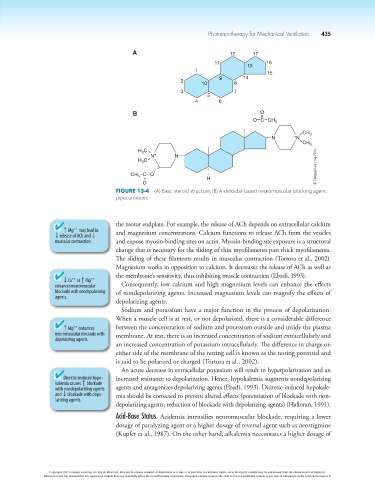
                                             Figure 13-4  (A) Basic steroid structure; (B) A steroidal-based neuromuscular blocking agent,
                                             pipecuronium.


                                             the motor endplate. For example, the release of ACh depends on extracellular calcium
                                ++
                            c Mg  may lead to   and magnesium concentrations. Calcium functions to release ACh from the vesicles
                          T release of ACh and T
                          muscular contraction.  and expose myosin-binding sites on actin. Myosin-binding site exposure is a structural
                                             change that is necessary for the sliding of thin myofilaments past thick myofilaments.
                                             The sliding of these filaments results in muscular contraction (Tortora et al., 2002).
                                             Magnesium works in opposition to calcium. It decreases the release of ACh as well as
                                             the membrane’s sensitivity, thus inhibiting muscle contraction (Ebadi, 1993).
                                     ++
                               ++
                            T Ca  or c Mg
                          enhances neuromuscular   Consequently, low calcium and high magnesium levels can enhance the effects
                          blockade with nondepolarizing   of nondepolarizing agents. Increased magnesium levels can magnify the effects of
                          agents.
                                             depolarizing agents.
                                               Sodium and potassium have a major function in the process of depolarization.
                                             When a muscle cell is at rest, or not depolarized, there is a considerable difference
                                ++
                            c Mg  enhances   between the concentration of sodium and potassium outside and inside the plasma
                          neuromuscular blockade with   membrane. At rest, there is an increased concentration of sodium extracellularly and
                          depolarizing agents.
                                             an increased concentration of potassium intracellularly. The difference in charge on
                                             either side of the membrane of the resting cell is known as the resting potential and
                                             is said to be polarized or charged (Tortora et al., 2002).
                                               An acute decrease in extracellular potassium will result in hyperpolarization and an
                            Diuretic-induced hypo-  increased resistance to depolarization. Hence, hypokalemia augments nondepolarizing
                          kalemia causes c blockade
                          with nondepolarizing agents   agents and antagonizes depolarizing agents (Ebadi, 1993). Diuretic-induced hypokale-
                          and T blockade with depo-  mia should be corrected to prevent altered effects (potentiation of blockade with non-
                          larizing agents.
                                             depolarizing agents; reduction of blockade with depolarizing agents) (Halloran, 1991).
                                             Acid-Base Status. Acidemia intensifies neuromuscular blockade, requiring a lower
                                             dosage of paralyzing agent or a higher dosage of reversal agent such as neostigmine
                                             (Kupfer et al., 1987). On the other hand, alkalemia necessitates a higher dosage of


                        Copyright 2013 Cengage Learning. All Rights Reserved. May not be copied, scanned, or duplicated, in whole or in part. Due to electronic rights, some third party content may be suppressed from the eBook and/or eChapter(s).
                      Editorial review has deemed that any suppressed content does not materially affect the overall learning experience. Cengage Learning reserves the right to remove additional content at any time if subsequent rights restrictions require it.

