


Page 55 - Clinical Application of Mechanical Ventilation
P. 55
Principles of Mechanical Ventilation  21


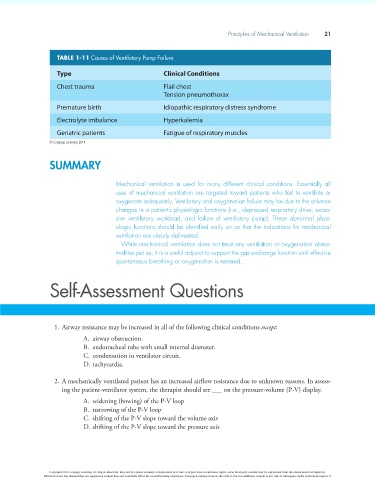
                          TABLE 1-11 Causes of Ventilatory Pump Failure

                          Type                               Clinical Conditions

                          Chest trauma                       Flail chest
                                                             Tension pneumothorax
                          Premature birth                    Idiopathic respiratory distress syndrome

                          Electrolyte imbalance              Hyperkalemia
                          Geriatric patients                 Fatigue of respiratory muscles

                        © Cengage Learning 2014

                        SUMMARY


                                             Mechanical ventilation is used for many different clinical conditions. Essentially all
                                             uses of mechanical ventilation are targeted toward patients who fail to ventilate or
                                             oxygenate adequately. Ventilatory and oxygenation failure may be due to the adverse
                                             changes in a patient’s physiologic functions (i.e., depressed respiratory drive, exces-
                                             sive  ventilatory  workload,  and  failure  of  ventilatory  pump).  These  abnormal  physi-
                                             ologic functions should be identified early on so that the indications for mechanical
                                             ventilation are clearly delineated.
                                               While mechanical ventilation does not treat any ventilation or oxygenation abnor-
                                             malities per se, it is a useful adjunct to support the gas exchange function until effective
                                             spontaneous breathing or oxygenation is restored.


                        Self-Assessment Questions


                          1. Airway resistance may be increased in all of the following clinical conditions except:
                                   A.  airway obstruction.
                                   B.  endotracheal tube with small internal diameter.
                                   C.  condensation in ventilator circuit.
                                   D. tachycardia.

                          2. A mechanically ventilated patient has an increased airflow resistance due to unknown reasons. In assess-
                            ing the patient-ventilator system, the therapist should see ___ on the pressure-volume (P-V) display.
                                   A.  widening (bowing) of the P-V loop
                                   B.  narrowing of the P-V loop
                                   C.  shifting of the P-V slope toward the volume axis
                                   D. shifting of the P-V slope toward the pressure axis


                        Copyright 2013 Cengage Learning. All Rights Reserved. May not be copied, scanned, or duplicated, in whole or in part. Due to electronic rights, some third party content may be suppressed from the eBook and/or eChapter(s).
                      Editorial review has deemed that any suppressed content does not materially affect the overall learning experience. Cengage Learning reserves the right to remove additional content at any time if subsequent rights restrictions require it.

