


Page 54 - Clinical Application of Mechanical Ventilation
P. 54
20     Chapter 1


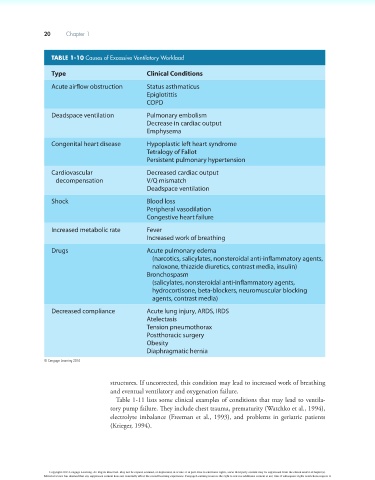
                        TABLE 1-10 Causes of Excessive Ventilatory Workload

                        Type                            Clinical Conditions

                        Acute airflow obstruction       Status asthmaticus
                                                        Epiglotittis
                                                        COPD

                        Deadspace ventilation           Pulmonary embolism
                                                        Decrease in cardiac output
                                                        Emphysema

                        Congenital heart disease        Hypoplastic left heart syndrome
                                                        Tetralogy of Fallot
                                                        Persistent pulmonary hypertension
                        Cardiovascular                  Decreased cardiac output
                           decompensation               V/Q mismatch
                                                        Deadspace ventilation
                        Shock                           Blood loss
                                                        Peripheral vasodilation
                                                        Congestive heart failure
                        Increased metabolic rate        Fever
                                                        Increased work of breathing
                        Drugs                           Acute pulmonary edema
                                                         (narcotics, salicylates, nonsteroidal anti-inflammatory agents,
                                                         naloxone, thiazide diuretics, contrast media, insulin)
                                                        Bronchospasm
                                                         (salicylates, nonsteroidal anti-inflammatory agents,
                                                         hydrocortisone, beta-blockers, neuromuscular blocking
                                                         agents, contrast media)

                        Decreased compliance            Acute lung injury, ARDS, IRDS
                                                        Atelectasis
                                                        Tension pneumothorax
                                                        Postthoracic surgery
                                                        Obesity
                                                        Diaphragmatic hernia
                      © Cengage Learning 2014


                                            structures. If uncorrected, this condition may lead to increased work of breathing
                                            and eventual ventilatory and oxygenation failure.
                                             Table 1-11 lists some clinical examples of conditions that may lead to ventila-
                                            tory pump failure. They include chest trauma, prematurity (Watchko et al., 1994),
                                            electrolyte  imbalance  (Freeman  et  al.,  1993),  and  problems  in  geriatric  patients
                                            (Krieger, 1994).


                        Copyright 2013 Cengage Learning. All Rights Reserved. May not be copied, scanned, or duplicated, in whole or in part. Due to electronic rights, some third party content may be suppressed from the eBook and/or eChapter(s).
                      Editorial review has deemed that any suppressed content does not materially affect the overall learning experience. Cengage Learning reserves the right to remove additional content at any time if subsequent rights restrictions require it.

