


Page 62 - Clinical Application of Mechanical Ventilation
P. 62
28     Chapter 2


                      PULMONARY CONSIDERATIONS


                                            This section compares the physiologic differences between spontaneous breathing
                                            and positive pressure ventilation. Two of the major effects are the changes in airway
                                            pressure and compliance.


                                            Spontaneous Breathing
                          During negative pressure
                        ventilation, pressures in
                        the airways, alveoli, and   During spontaneous ventilation, the diaphragm and other respiratory muscles cre-
                        pleura are decreased during   ate gas flow by lowering the pleural, alveolar, and airway pressures. When alveolar
                        inspiration.
                                            and airway pressures drop below atmospheric pressure, air flows into the lungs.
                                            Negative pressure ventilation uses this principle by creating a negative pressure on
                                            the chest wall. When negative pressure is used for ventilation, the pressures in the
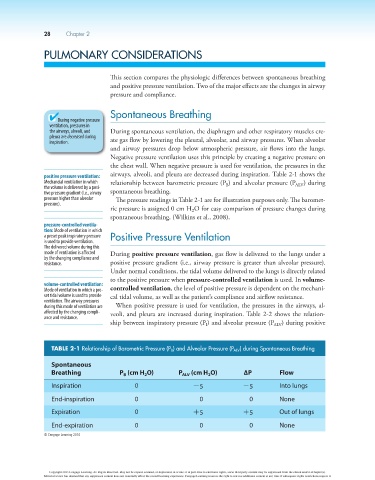
                      positive pressure ventilation:   airways, alveoli, and pleura are decreased during inspiration. Table 2-1 shows the
                      Mechancial ventilation in which   relationship between barometric pressure (P ) and alveolar pressure (P  ) during
                      the volume is delivered by a posi-                         B                      ALV
                      tive pressure gradient (i.e., airway   spontaneous breathing.
                      pressure higher than alveolar   The pressure readings in Table 2-1 are for illustration purposes only. The baromet-
                      pressure).
                                            ric pressure is assigned 0 cm H O for easy comparison of pressure changes during
                                                                      2
                                            spontaneous breathing. (Wilkins et al., 2008).
                      pressure-controlled ventila-
                      tion: Mode of ventilation in which
                      a preset peak inspiratory pressure   Positive Pressure Ventilation
                      is used to provide ventilation.
                      The delivered volume during this
                      mode of ventilation is affected   During positive pressure ventilation, gas flow is delivered to the lungs under a
                      by the changing compliance and
                      resistance.           positive pressure gradient (i.e., airway pressure is greater than alveolar pressure).
                                            Under normal conditions, the tidal volume delivered to the lungs is directly related
                                            to the positive pressure when pressure-controlled ventilation is used. In volume-
                      volume-controlled ventilation:
                      Mode of ventilation in which a pre-  controlled ventilation, the level of positive pressure is dependent on the mechani-
                      set tidal volume is used to provide   cal tidal volume, as well as the patient’s compliance and airflow resistance.
                      ventilation. The airway pressures
                      during this mode of ventilation are   When positive pressure is used for ventilation, the pressures in the airways, al-
                      affected by the changing compli-  veoli, and pleura are increased during inspiration. Table 2-2 shows the relation-
                      ance and resistance.
                                            ship between inspiratory pressure (P ) and alveolar pressure (P ALV ) during positive
                                                                           I


                        TABLE 2-1  Relationship of Barometric Pressure (P B ) and Alveolar Pressure (P ALV ) during Spontaneous Breathing


                        Spontaneous
                        Breathing              P  (cm H O)        P ALV  (cm H O)      ∆P          Flow
                                                                            2
                                                B
                                                       2
                        Inspiration                 0                  25              25          Into lungs
                        End-inspiration             0                      0               0       None
                        Expiration                  0                  15              15          Out of lungs

                        End-expiration              0                      0               0       None
                      © Cengage Learning 2014


                        Copyright 2013 Cengage Learning. All Rights Reserved. May not be copied, scanned, or duplicated, in whole or in part. Due to electronic rights, some third party content may be suppressed from the eBook and/or eChapter(s).
                      Editorial review has deemed that any suppressed content does not materially affect the overall learning experience. Cengage Learning reserves the right to remove additional content at any time if subsequent rights restrictions require it.

