


Page 65 - Clinical Application of Mechanical Ventilation
P. 65
Effects of Positive Pressure Ventilation  31


                                                         50                          B
                                                     Mean Airway Pressure  (cm H 2 O)  30
                                                         40


                                                         20
                                                                  A
                                                         10
                                                                                                        Mode  © Cengage Learning 2014
                                                                      CPAP             PPV + PEEP
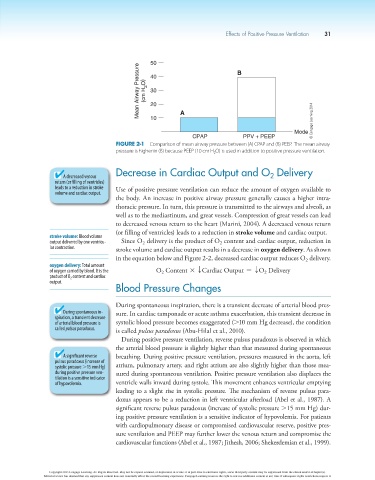
                                             Figure 2-1  Comparison of mean airway pressure between (A) CPAP and (B) PEEP.  The mean airway
                                             pressure is higher in (B) because PEEP (10 cm H 2 O) is used in addition to positive pressure ventilation.


                                             Decrease in Cardiac Output and O  Delivery
                            A decreased venous                                                  2
                          return (or filling of ventricles)
                          leads to a reduction in stroke   Use of positive pressure ventilation can reduce the amount of oxygen available to
                          volume and cardiac output.
                                             the body. An increase in positive airway pressure generally causes a higher intra-
                                             thoracic pressure. In turn, this pressure is transmitted to the airways and alveoli, as
                                             well as to the mediastinum, and great vessels. Compression of great vessels can lead
                                             to decreased venous return to the heart (Marini, 2004). A decreased venous return
                                             (or filling of ventricles) leads to a reduction in stroke volume and cardiac output.
                        stroke volume: Blood volume
                        output delivered by one ventricu-  Since O  delivery is the product of O  content and cardiac output, reduction in
                                                      2
                                                                               2
                        lar contraction.     stroke volume and cardiac output results in a decrease in oxygen delivery. As shown
                                             in the equation below and Figure 2-2, decreased cardiac output reduces O  delivery.
                                                                                                           2
                        oxygen delivery: Total amount
                        of oxygen carried by blood. It is the   O  Content * TCardiac Output = TO  Delivery
                                                                                              2
                                                            2
                        product of O 2  content and cardiac
                        output.
                                             Blood Pressure Changes
                                             During spontaneous inspiration, there is a transient decrease of arterial blood pres-
                            During spontaneous in-  sure. In cardiac tamponade or acute asthma exacerbation, this transient decrease in
                          spiration, a transient decrease
                          of arterial blood pressure is   systolic blood pressure becomes exaggerated (.10 mm Hg decrease), the condition
                          called pulsus paradoxus.  is called pulsus paradoxus (Abu-Hilal et al., 2010).
                                               During positive pressure ventilation, reverse pulsus paradoxus is observed in which
                                             the arterial blood pressure is slightly higher than that measured during spontaneous
                            A significant reverse   breathing. During positive pressure ventilation, pressures measured in the aorta, left
                          pulsus paradoxus (increase of
                          systolic pressure .15 mm Hg)   atrium, pulmonary artery, and right atrium are also slightly higher than those mea-
                          during positive pressure ven-  sured during spontaneous ventilation. Positive pressure ventilation also displaces the
                          tilation is a sensitive indicator
                          of hypovolemia.    ventricle walls inward during systole. This movement enhances ventricular emptying
                                             leading to a slight rise in systolic pressure. The mechanism of reverse pulsus para-
                                             doxus appears to be a reduction in left ventricular afterload (Abel et al., 1987). A
                                             significant reverse pulsus paradoxus (increase of systolic pressure .15 mm Hg) dur-
                                             ing positive pressure ventilation is a sensitive indicator of hypovolemia. For patients
                                             with cardiopulmonary disease or compromised cardiovascular reserve, positive pres-
                                             sure ventilation and PEEP may further lower the venous return and compromise the
                                             cardiovascular functions (Abel et al., 1987; Jithesh, 2006; Shekerdemian et al., 1999).


                        Copyright 2013 Cengage Learning. All Rights Reserved. May not be copied, scanned, or duplicated, in whole or in part. Due to electronic rights, some third party content may be suppressed from the eBook and/or eChapter(s).
                      Editorial review has deemed that any suppressed content does not materially affect the overall learning experience. Cengage Learning reserves the right to remove additional content at any time if subsequent rights restrictions require it.

