


Page 71 - Clinical Application of Mechanical Ventilation
P. 71
Effects of Positive Pressure Ventilation  37


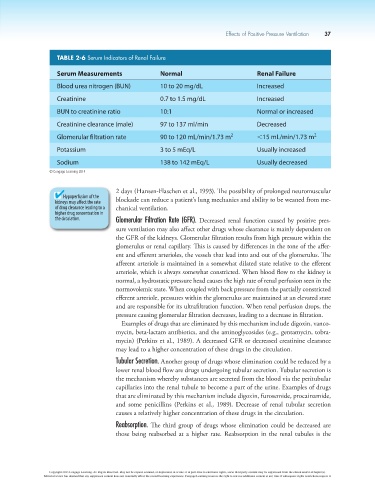
                          TABLE 2-6 Serum Indicators of Renal Failure

                          Serum Measurements                Normal                          Renal Failure

                          Blood urea nitrogen (BUN)         10 to 20 mg/dL                  Increased

                          Creatinine                        0.7 to 1.5 mg/dL                Increased
                          BUN to creatinine ratio           10:1                            Normal or increased

                          Creatinine clearance (male)       97 to 137 ml/min                Decreased
                          Glomerular filtration rate        90 to 120 mL/min/1.73 m 2       ,15 mL/min/1.73 m 2

                          Potassium                         3 to 5 mEq/L                    Usually increased
                          Sodium                            138 to 142 mEq/L                Usually decreased

                        © Cengage Learning 2014

                                             2 days (Hansen-Flaschen et al., 1993). The possibility of prolonged neuromuscular
                            Hypoperfusion of the
                          kidneys may affect the rate   blockade can reduce a patient’s lung mechanics and ability to be weaned from me-
                          of drug clearance leading to a   chanical ventilation.
                          higher drug concentration in
                          the circulation.   Glomerular Filtration Rate (GFR). Decreased renal function caused by positive pres-
                                             sure ventilation may also affect other drugs whose clearance is mainly dependent on
                                             the GFR of the kidneys. Glomerular filtration results from high pressure within the
                                             glomerulus or renal capillary. This is caused by differences in the tone of the affer-
                                             ent and efferent arterioles, the vessels that lead into and out of the glomerulus. The
                                             afferent arteriole is maintained in a somewhat dilated state relative to the efferent
                                             arteriole, which is always somewhat constricted. When blood flow to the kidney is
                                             normal, a hydrostatic pressure head causes the high rate of renal perfusion seen in the
                                             normovolemic state. When coupled with back pressure from the partially constricted
                                             efferent arteriole, pressures within the glomerulus are maintained at an elevated state
                                             and are responsible for its ultrafiltration function. When renal perfusion drops, the
                                             pressure causing glomerular filtration decreases, leading to a decrease in filtration.
                                               Examples of drugs that are eliminated by this mechanism include digoxin, vanco-
                                             mycin, beta-lactam antibiotics, and the aminoglycosides (e.g., gentamycin, tobra-
                                             mycin) (Perkins et al., 1989). A decreased GFR or decreased creatinine clearance
                                             may lead to a higher concentration of these drugs in the circulation.

                                             Tubular Secretion. Another group of drugs whose elimination could be reduced by a
                                             lower renal blood flow are drugs undergoing tubular secretion. Tubular secretion is
                                             the mechanism whereby substances are secreted from the blood via the peritubular
                                             capillaries into the renal tubule to become a part of the urine. Examples of drugs
                                             that are eliminated by this mechanism include digoxin, furosemide, procainamide,
                                             and  some  penicillins  (Perkins  et  al.,  1989).  Decrease  of  renal  tubular  secretion
                                             causes a relatively higher concentration of these drugs in the circulation.
                                             Reabsorption. The third group of drugs whose elimination could be decreased are
                                             those being reabsorbed at a higher rate. Reabsorption in the renal tubules is the


                        Copyright 2013 Cengage Learning. All Rights Reserved. May not be copied, scanned, or duplicated, in whole or in part. Due to electronic rights, some third party content may be suppressed from the eBook and/or eChapter(s).
                      Editorial review has deemed that any suppressed content does not materially affect the overall learning experience. Cengage Learning reserves the right to remove additional content at any time if subsequent rights restrictions require it.

