


Page 69 - Clinical Application of Mechanical Ventilation
P. 69
Effects of Positive Pressure Ventilation  35


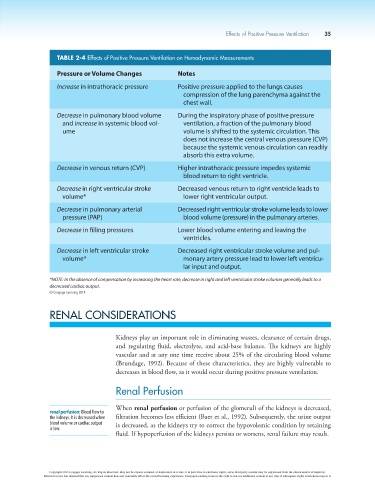
                          TABLE 2-4 Effects of Positive Pressure Ventilation on Hemodynamic Measurements

                          Pressure or Volume Changes              Notes

                          Increase in intrathoracic pressure      Positive pressure applied to the lungs causes
                                                                   compression of the lung parenchyma against the
                                                                   chest wall.

                          Decrease in pulmonary blood volume      During the inspiratory phase of positive pressure
                            and increase in systemic blood vol-    ventilation, a fraction of the pulmonary blood
                            ume                                    volume is shifted to the systemic circulation. This
                                                                   does not increase the central venous pressure (CVP)
                                                                   because the systemic venous circulation can readily
                                                                   absorb this extra volume.

                          Decrease in venous return (CVP)         Higher intrathoracic pressure impedes systemic
                                                                   blood return to right ventricle.

                          Decrease in right ventricular stroke    Decreased venous return to right ventricle leads to
                            volume*                                lower right ventricular output.

                          Decrease in pulmonary arterial          Decreased right ventricular stroke volume leads to lower
                            pressure (PAP)                         blood volume (pressure) in the pulmonary arteries.
                          Decrease in filling pressures           Lower blood volume entering and leaving the
                                                                   ventricles.
                          Decrease in left ventricular stroke     Decreased right ventricular stroke volume and pul-
                            volume*                                monary artery pressure lead to lower left ventricu-
                                                                   lar input and output.
                        *NOTE: In the absence of compensation by increasing the heart rate, decrease in right and left ventricular stroke volumes generally leads to a
                        decreased cardiac output.
                        © Cengage Learning 2014


                        RENAL CONSIDERATIONS


                                             Kidneys play an important role in eliminating wastes, clearance of certain drugs,
                                             and regulating fluid, electrolyte, and acid-base balance. The kidneys are highly
                                             vascular and at any one time receive about 25% of the circulating blood volume
                                             (Brundage, 1992). Because of these characteristics, they are highly vulnerable to
                                             decreases in blood flow, as it would occur during positive pressure ventilation.

                                             Renal Perfusion


                                             When renal perfusion or perfusion of the glomeruli of the kidneys is decreased,
                        renal perfusion: Blood flow to
                        the kidneys. It is decreased when   filtration becomes less efficient (Baer et al., 1992). Subsequently, the urine output
                        blood volume or cardiac output   is decreased, as the kidneys try to correct the hypovolemic condition by retaining
                        is low.
                                             fluid. If hypoperfusion of the kidneys persists or worsens, renal failure may result.


                        Copyright 2013 Cengage Learning. All Rights Reserved. May not be copied, scanned, or duplicated, in whole or in part. Due to electronic rights, some third party content may be suppressed from the eBook and/or eChapter(s).
                      Editorial review has deemed that any suppressed content does not materially affect the overall learning experience. Cengage Learning reserves the right to remove additional content at any time if subsequent rights restrictions require it.

