


Page 99 - Cardiac Nursing
P. 99
p06
                                                       pta
                         96.
                       9-0
                                                    5 A
                                                 g
                                                         ra
                                                  e 7
                           qxd
                                           1 A
                                        8:4
                                               P
                                             M
                                9/0
                               0
                                    009
                                  9/2
            K34
               0-c
                 03_
         L L LWB K34 0-c 03_ p06 9-0 96. qxd  0 9/0 9/2 009  0 0 8:4 1 A M  P a a g e 7 5 A pta ra
         LWB
         LWBK340-c03_p069-096.qxd  09/09/2009  08:41 AM  Page 75 Aptara
                                                          C HAPTER  3 / Regulation of Cardiac Output and Blood Pressure  75
                   ble for 10% to 20% of vasodilation in response to hyperther-     Adrenergic terminal neuron
                   mia. 67,68,73  Cholinergic nerves, which innervate the sweat glands, re-
                   lease a yet to be described co-transmitter that may be functionally
                                                                                   z
                                                                               Depolarization       m 2
                                                                                                        a
                                                                                                         l
                   linked to the large and important active cutaneous vasodilation seen  adrenerrgic     inhibition
                                                                                                      Vag l
                                                                                                        o
                   in heat stress. 69,73,74  Additionally, under conditions of hyperthermia,  NE
                   nitric oxide is necessary for the vasodilatory response. 69  Endothelial    , A-II
                                                                                     2
                   nitric oxide (eNOS) is responsible for vasodilation in response to lo-           ade NO s i n e
                                                                                                      o
                                                                                                   adenosine
                                                                                                     n
                                                                                       Re-
                                                                                       Re
                                  75
                   cal cutaneous heating, whereas neuronal nitric oxide (nNOS) is re-  uptake  NE    2
                                                              76
                   sponsible for vasodilation in response to whole-body heating. The  E             Angio-II
                   cutaneous veins constrict in response to local cold and are reflexly          1  A-II  Opie (2003)
                   constricted in response a decrease in skin or core body temperature. 77        2  Vascu ar smooth
                                                                                                        la
                     Nonthermoregulatory control of the cutaneous circulation via                      m muscle
                                                                                             Vasoconstrict
                   the arterial and cardiopulmonary baroreflexes plays a role in blood
                                                                                      Vasodilate
                   pressure control. For example, under normothermic conditions,
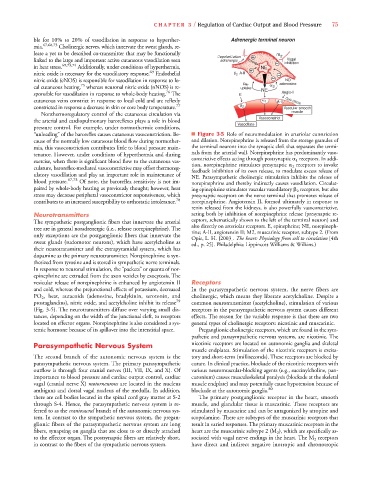
                   “unloading” of the baroreflex causes cutaneous vasoconstriction. Be-  ■ Figure 3-5 Role of neuromodulation in arteriolar constriction
                   cause of the normally low cutaneous blood flow during normother-  and dilation. Norepinephrine is released from the storage granules of
                   mia, this vasoconstriction contributes little to blood pressure main-  the terminal neurons into the synaptic cleft that separates the termi-
                   tenance. However, under conditions of hyperthermia and during  nals from the arterial wall. Norepinephrine has predominantly vaso-
                   exercise, when there is significant blood flow to the cutaneous vas-  constrictive effects acting through postsynaptic   1 receptors. In addi-
                                                                       tion, norepinephrine stimulates presynaptic   2 receptors to invoke
                   culature, baroreflex-mediated vasoconstrictive may offset thermoreg-  feedback inhibition of its own release, to modulate excess release of
                   ulatory vasodilation and play an important role in maintenance of  NE. Parasympathetic cholinergic stimulation inhibits the release of
                   blood pressure. 67,73  Of note, the baroreflex sensitivity is not im-  norepinephrine and thereby indirectly causes vasodilation. Circulat-
                   paired by whole-body heating as previously thought; however, heat  ing epinephrine stimulates vascular vasodilatory   2 receptors, but also
                   stress may decrease peripheral vasoconstrictor responsiveness, which  presynaptic receptors on the nerve terminal that promotes release of
                   contributes to an increased susceptibility to orthostatic intolerance. 78  norepinephrine. Angiotensin II, formed ultimately in response to
                                                                       renin released from the kidneys, is also powerfully vasoconstrictive,
                   Neurotransmitters                                   acting both by inhibition of norepinephrine release (presynaptic re-
                   The sympathetic postganglionic fibers that innervate the arterial  ceptors, schematically shown to the left of the terminal neuron) and
                   tree are in general noradrenergic (i.e., release norepinephrine). The  also directly on arteriolar receptors. E, epinephrine; NE, norepineph-
                                                                       rine; A-II, angiotensin II; M2, muscarinic receptor, subtype 2. (From
                   only exceptions are the postganglionic fibers that innervate the  Opie, L. H. [2003]. The heart: Physiology from cell to circulation [4th
                   sweat glands (sudomotor neurons), which have acetylcholine as  ed., p. 25]. Philadelphia: Lippincott Williams & Wilkins.)
                   their neurotransmitter and the extrapyramidal system, which has
                   dopamine as the primary neurotransmitter. Norepinephrine is syn-
                   thesized from tyrosine and is stored in sympathetic nerve terminals.
                   In response to neuronal stimulation, the “packets” or quanta of nor-
                   epinephrine are extruded from the axon vesicles by exocytosis. The
                   vesicular release of norepinephrine is enhanced by angiotensin II  Receptors
                   and cold, whereas the prejunctional effects of potassium, decreased  In the  parasympathetic nervous system, the nerve  fibers are
                   PO 2 , heat, autacoids (adenosine, bradykinin, serotonin, and  cholinergic, which means they liberate acetylcholine. Despite a
                   prostaglandins), nitric oxide, and acetylcholine inhibit its release 79  common neurotransmitter (acetylcholine), stimulation of various
                   (Fig. 3-5). The neurotransmitters diffuse over varying small dis-  receptors in the parasympathetic nervous system causes different
                   tances, depending on the width of the junctional cleft, to receptors  effects. The reason for the variable response is that there are two
                   located on effector organs. Norepinephrine is also considered a sys-  general types of cholinergic receptors: nicotinic and muscarinic.
                   temic hormone because of its spillover into the interstitial space.  Preganglionic cholinergic receptors, which are found in the sym-
                                                                       pathetic and parasympathetic nervous systems, are nicotinic. The
                   Parasympathetic Nervous System                      nicotinic receptors are located on autonomic ganglia and skeletal
                                                                       muscle endplates. Stimulation of the nicotinic receptors is excita-
                   The second  branch of the autonomic nervous system is the  tory and short-term (milliseconds). These receptors are blocked by
                   parasympathetic nervous system. The primary parasympathetic  curare. In clinical practice, blockade of the nicotinic receptors with
                   outflow is through four cranial nerves (III, VII, IX, and X). Of  various neuromuscular-blocking agents (e.g., succinylcholine, pan-
                   importance to blood pressure and cardiac output control, cardiac  curonium) causes musculoskeletal paralysis (blockade at the skeletal
                   vagal (cranial nerve X) motorneurons are located in the nucleus  muscle endplate) and may potentially cause hypotension because of
                   ambiguus and dorsal vagal nucleus of the medulla. In addition,  blockade at the autonomic ganglia. 80
                   there are cell bodies located in the spinal cord gray matter at S-2  The primary postganglionic receptor in the heart, smooth
                   through S-4. Hence, the parasympathetic nervous system is re-  muscle, and glandular tissue is muscarinic. These receptors are
                   ferred to as the craniosacral branch of the autonomic nervous sys-  stimulated by muscarine and can be antagonized by atropine and
                   tem. In contrast to the sympathetic nervous system, the pregan-  scopolamine. There are subtypes of the muscarinic receptors that
                   glionic fibers of the parasympathetic nervous system are long  result in varied responses. The primary muscarinic receptors in the
                   fibers, synapsing on ganglia that are close to or directly attached  heart are the muscarinic subtype 2 (M 2 ), which are specifically as-
                   to the effector organ. The postsynaptic fibers are relatively short,  sociated with vagal nerve endings in the heart. The M 2 receptors
                   in contrast to the fibers of the sympathetic nervous system.  have direct and indirect negative inotropic and chronotropic

