


Page 96 - Cardiac Nursing
P. 96
P
                                                 g
                    p06
                                             M
                                                       pta
                                                         ra
                                                  e 7
                                                    2 A
                       9-0
                                        8:4
                                           1 A
                                    009
                                  9/2
                           qxd
                         96.
                                9/0
                               0
            K34
               0-c
                 03_
         LWB K34 0-c 03_ p06 9-0 96. qxd  0 9/0 9/2 009  0 0 8:4 1 A M  P a a g e 7 2 A pta ra
         L L LWB
         LWBK340-c03_p069-096.qxd  09/09/2009  08:41 AM  Page 72 Aptara
                  72    PA R T  I / Anatomy and Physiology
                                         SP fibers       nonNMDA receptors    SP, GLU neurons
                                         GLU fibers      NMDA receptors       GLU neurons
                                         GABA fibers     NKI receptors        GABA neurons       Medulla
                                                                                                   RVLM
                                    Nodose
                                    ganglion           Petrosal
                                                       ganglion
                                                             NTS
                                             SP
                            Aortic    Carotid
                            arch      sinus
                              Baroreceptors                    NA
                                                                                   CVLM
                                                                                                            IM
                                                                                                            IML
                                                                                                            I I I I I I
                                                                                                            IM
                                          Parasympathetic              Medulla           Sympathetic
                                          activity
                                                                                         activity       Spinal cord
                                                    Heart
                                                                                                Heart
                                                                                                Blood vessels
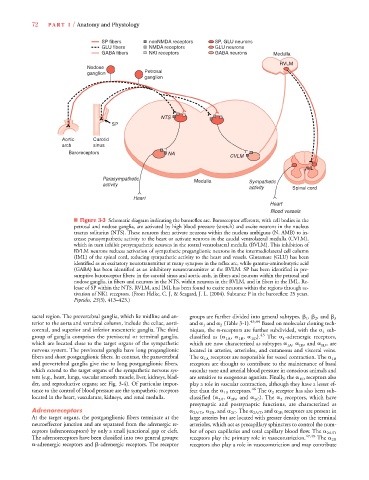
                                ■ Figure 3-3 Schematic diagram indicating the baroreflex arc. Baroreceptor afferents, with cell bodies in the
                                petrosal and nodose ganglia, are activated by high blood pressure (stretch) and excite neurons in the nucleus
                                tractus solitarius (NTS). These neurons then activate neurons within the nucleus ambiguus (N. AMB) to in-
                                crease parasympathetic activity to the heart or activate neurons in the caudal ventrolateral medulla (CVLM),
                                which in turn inhibit presympathetic neurons in the rostral ventrolateral medulla (RVLM). This inhibition of
                                RVLM neurons reduces activation of sympathetic preganglionic neurons in the intermediolateral cell column
                                (IML) of the spinal cord, reducing sympathetic activity to the heart and vessels. Glutamate (GLU) has been
                                identified as an excitatory neurotransmitter at many synapses in the reflex arc, while gamma-aminobutyric acid
                                (GABA) has been identified as an inhibitory neurotransmitter at the RVLM. SP has been identified in pre-
                                sumptive baroreceptor fibers: in the carotid sinus and aortic arch, in fibers and neurons within the petrosal and
                                nodose ganglia, in fibers and neurons in the NTS, within neurons in the RVLM, and in fibers in the IML. Re-
                                lease of SP within the NTS, RVLM, and IML has been found to excite neurons within the regions through ac-
                                tivation of NK1 receptors. (From Helke, C. J, & Seagard, J. L. (2004). Subtance P in the baroreflex: 25 years.
                                Peptides, 25(3), 413–423.)

                  sacral region. The prevertebral ganglia, which lie midline and an-  groups are further divided into general subtypes,   1 ,   2 , and   3
                  terior to the aorta and vertebral column, include the celiac, aorti-  and   1 and   2 (Table 3-1). 43,44  Based on molecular cloning tech-
                  corenal, and superior and inferior mesenteric ganglia. The third  niques, the  -receptors are further subdivided, with the   1 sub-
                  group of ganglia comprises the previsceral or terminal ganglia,  classified as  (  1A ,    1B ,    1D ). 45  The   1 -adrenergic receptors,
                  which are located close to the target organs of the sympathetic  which are now characterized as subtypes   1A ,   1B , and   1D , are
                  nervous system. The previsceral ganglia have long preganglionic  located in arteries, arterioles, and cutaneous and visceral veins.
                  fibers and short postganglionic fibers. In contrast, the paravertebral  The   1A receptors are responsible for vessel contraction. The   1B
                  and prevertebral ganglia give rise to long postganglionic fibers,  receptors are thought to contribute to the maintenance of basal
                  which extend to the target organs of the sympathetic nervous sys-  vascular tone and arterial blood pressure in conscious animals and
                  tem (e.g., heart, lungs, vascular smooth muscle, liver, kidneys, blad-  are sensitive to exogenous agonists. Finally, the   1D receptors also
                  der, and reproductive organs; see Fig. 3-4). Of particular impor-  play a role in vascular contraction, although they have a lesser ef-
                                                                                          46
                  tance to the control of blood pressure are the sympathetic receptors  fect than the   1B receptors. The   2 receptor has also been sub-
                  located in the heart, vasculature, kidneys, and renal medulla.  classified (  2A ,   2B , and   2C ). The   2 receptors, which have
                                                                      presynaptic and  postsynaptic functions, are characterized as
                  Adrenoreceptors                                       2A/D ,   2B , and   2C . The   2A/D and   2B receptors are present in
                  At the target organs, the postganglionic fibers terminate at the  large arteries but are located with greater density on the terminal
                  neuroeffector junction and are separated from the adrenergic re-  arterioles, which act as precapillary sphincters to control the num-
                  ceptors (adrenoreceptors) by only a small junctional gap or cleft.  ber of open capillaries and total capillary blood flow. The   2A/D
                  The adrenoreceptors have been classified into two general groups:  receptors play the primary role in vasoconstriction. 47,48  The   2B
                   -adrenergic receptors and  -adrenergic receptors. The receptor  receptors also play a role in vasoconstriction and may contribute

