


Page 98 - Cardiac Nursing
P. 98
LWBK340-c03_p069-096.qxd  09/09/2009  08:41 AM  Page 74 Aptara


                  74    PA R T  I / Anatomy and Physiology


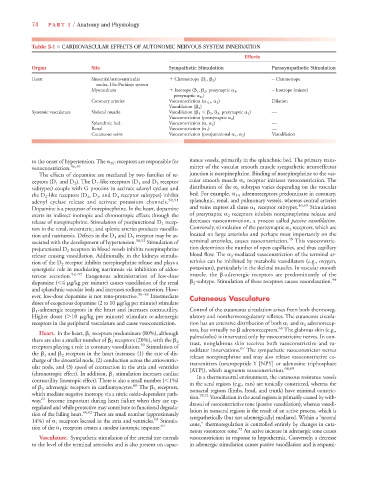
                  Table 3-1 ■ CARDIOVASCULAR EFFECTS OF AUTONOMIC NERVOUS SYSTEM INNERVATION
                                                                                        Effects
                  Organ               Site                     Sympathetic Stimulation           Parasympathetic Stimulation
                  Heart               Sinoatrial/atrioventricular
 Chronotrope (  1 ,   2 )    –  Chronotrope
                                        nodes, His-Purkinje system
                                      Myocardium
 Inotrope (  1 ,   2 , presynaptic   1 ,   – Inotrope (minor)
                                                                 presynaptic   2c )
                                      Coronary arteries        Vasoconstriction (  1D ,   2 )    Dilation
                                                               Vasodilation (  2 )
                  Systemic vasculature  Skeletal muscle        Vasodilation (  1     2 ,   3 , presynaptic   2 )  —
                                                               Vasoconstriction (postsynaptic   2 )
                                      Splanchnic bed           Vasoconstriction ( ,   2 )        —
                                      Renal                    Vasoconstriction (  1 )           —
                                      Cutaneous veins          Vasoconstriction (postjunctional   1 ,   2 )  Vasodilation


                  to the onset of hypertension. The   2C receptors are responsible for  itance vessels, primarily in the splanchnic bed. The primary trans-
                  venoconstriction. 46,49                             mitter of the vascular smooth muscle sympathetic neuroeffector
                     The effects of dopamine are mediated by two families of re-  junction is norepinephrine. Binding of norepinephrine to the vas-
                  ceptors (D 1 and D 2 ). The D 1 -like receptors (D 1 and D 5 receptor  cular smooth muscle   1 receptor initiates vasoconstriction. The
                  subtypes) couple with G proteins to activate adenyl cyclase and  distribution of the   1 subtypes varies depending on the vascular
                  the D 2 -like receptors (D 2 , D 3 , and D 4 receptor subtypes) inhibit  bed. For example,   1A adrenoreceptors predominate in coronary,
                  adenyl cyclase release and activate potassium channels. 50,51  splanchnic, renal, and pulmonary vessels, whereas central arteries
                  Dopamine is a precursor of norepinephrine. In the heart, dopamine  and veins express all three   1 receptor subtypes. 46,65  Stimulation
                  exerts its indirect inotropic and chronotropic effects through the  of presynaptic   2 receptors inhibits norepinephrine release and
                  release of norepinephrine. Stimulation of postjunctional D 1 recep-  decreases vasoconstriction, a process called passive vasodilation.
                  tors in the renal, mesenteric, and splenic arteries produces vasodila-  Conversely, stimulation of the postsynaptic   2 receptors, which are
                  tion and natriuresis. Defects in the D 1 and D 5 receptor may be as-  located on large arterioles and perhaps most importantly on the
                  sociated with the development of hypertension. 50,52  Stimulation of  terminal arterioles, causes vasoconstriction. 49  This vasoconstric-
                  prejunctional D 2 receptors in blood vessels inhibits norepinephrine  tion determines the number of open capillaries, and thus capillary
                  release causing vasodilation. Additionally, in the kidneys stimula-  blood flow. The   2 -mediated vasoconstriction of the terminal ar-
                  tion of the D 2 receptor inhibits norepinephrine release and plays a  terioles can be inhibited by metabolic vasodilators (e.g., oxygen,
                  synergistic role in modulating natriuresis via inhibition of aldos-  potassium), particularly in the skeletal muscles. In vascular smooth
                  terone secretion. 52–55  Exogenous administration of  low-dose  muscle, the  -adrenergic receptors are predominantly of the
                  dopamine ( 4  g/kg per minute) causes vasodilation of the renal    2 -subtype. Stimulation of these receptors causes vasorelaxation. 44
                  and splanchnic vascular beds and increases sodium excretion. How-
                  ever, low-dose dopamine is not reno-protective. 56–58  Intermediate  Cutaneous Vasculature
                  doses of exogenous dopamine (2 to 10  g/kg per minute) stimulate
                    1 -adrenergic receptors in the heart and increases contractility.  Control of the cutaneous circulation arises from both thermoreg-
                  Higher doses ( 10  g/kg per minute) stimulate  -adrenergic  ulatory and nonthermoregulatory reflexes. The cutaneous circula-
                  receptors in the peripheral vasculature and cause vasoconstriction.  tion has an extensive distribution of both   1 and   2 adrenorecep-
                                                                                                   66
                                                                      tors, but virtually no   adrenoreceptors. The glabrous skin (e.g.,
                     Heart. In the heart,   1 receptors predominate (80%), although
                                                                      palms/soles) is innervated only by vasoconstrictive nerves. In con-
                  there are also a smaller number of   2 receptors (20%), with the   2  trast, nonglabrous skin receives both vasoconstrictive and va-
                                                      59
                  receptors playing a role in coronary vasodilation. Stimulation of  sodilator innervations. 67  The sympathetic vasoconstrictor nerves
                  the   1 and   2 receptors in the heart increases: (1) the rate of dis-  release norepinephrine and may also release vasoconstrictive co-
                  charge of the sinoatrial node, (2) conduction across the atrioventric-  transmitters (neuropeptide Y [NPY] or adenosine triphosphate
                  ular node, and (3) speed of contraction in the atria and ventricles  [ATP]), which augments vasoconstriction. 68,69
                  (chronotropic effect). In addition,   1 stimulation increases cardiac  In a thermoneutral environment, the cutaneous resistance vessels
                  contractility (inotropic effect). There is also a small number ( 1%)  in the acral regions (e.g., ears) are tonically constricted, whereas the
                  of   3 adrenergic receptors in cardiomyocytes. 60  The   3 receptors,  nonacral regions (limbs, head, and trunk) have minimal constric-
                  which mediate negative inotropy via a nitric oxide-dependent path-  tion. 70,71 Vasodilation in the acral regions is primarily caused by with-
                  way, 61  become important during heart failure when they are up-  drawal of vasoconstrictive tone (passive vasodilation), whereas vasodi-
                  regulated and while protective may contribute to functional degrada-  lation in nonacral regions is the result of an active process, which is
                  tion of the failing heart. 60,62  There are small number (approximately  sympathetically (but not adrenergically) mediated. Within a “neutral
                  14%) of   1 receptors located in the atria and ventricles. 63  Stimula-  zone,” thermoregulation is controlled entirely by changes in cuta-
                  tion of the   1 receptors creates a modest inotropic response. 64   72
                                                                      neous vasomotor tone. An active increase in adrenergic tone causes
                     Vasculature. Sympathetic stimulation of the arterial tree extends  vasoconstriction in response to hypothermia. Conversely, a decrease
                  to the level of the terminal arterioles and is also present on capac-  in adrenergic stimulation causes passive vasodilation and is responsi-

