


Page 165 - Cardiac Nursing
P. 165
9/2
                                  9/2
                                9/0
                               0
                                9/0
                                        0
                                        8:2
                                        0
                                    009
                                    009
                       2-1
                         52.
                       2-1
                    p13
                    p13
                           qxd
                               0
                           qxd
                         52.
                         52.
                                        8:2
                                                    41
                                                    41
                                                  e 1
                                                 g
                                                  e 1
                                                         ara
                                                         ara
                                                       Apt
                                                    41
                                                       Apt
                                             M
                                               P
                                             M
                                           5 A
                                           5 A
                                                a
                                                 g
                                                a
                                               P
                                               P
            K34
            K34
         L L LWB
            K34
                 06_
                 06_
               0-c
               0-c
         LWB
         LWBK340-c06_06_p132-152.qxd  09/09/2009  08:25 AM  Page 141 Aptara
                                                               C HAPTER  6 / Hematopoiesis, Coagulation, and Bleeding  141
                                                                               Underlying disease
                                                                                 or condition
                                                                                 Stimulation of
                                                                              coagulation cascade
                                                                  Fibrin                                Activation
                                                               clot formation                          of fibrinolysis
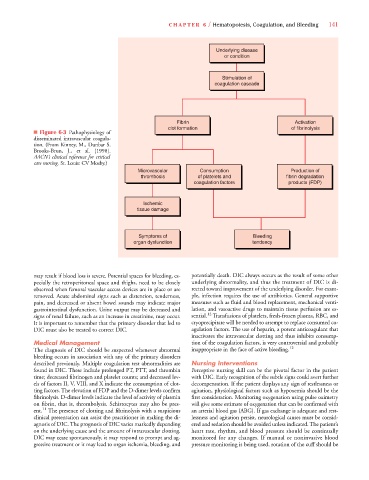
                   ■ Figure 6-3 Pathophysiology of
                   disseminated intravascular coagula-
                   tion. (From Kinney, M., Dunbar S.
                   Brooks-Brun,  J., et al. [1998].
                   AACN’s clinical reference for critical
                   care nursing. St. Louis: CV Mosby.)
                                                     Microvascular       Consumption                   Production of
                                                      thrombosis         of platelets and             fibrin degradation
                                                                       coagulation factors            products (FDP)
                                                       Ischemic
                                                     tissue damage
                                                     Symptoms of                           Bleeding
                                                    organ dysfunction                      tendency
                   may result if blood loss is severe. Potential spaces for bleeding, es-  potentially death. DIC always occurs as the result of some other
                   pecially the retroperitoneal space and thighs, need to be closely  underlying abnormality, and thus the treatment of DIC is di-
                   observed when femoral vascular access devices are in place or are  rected toward improvement of the underlying disorder. For exam-
                   removed. Acute abdominal signs such as distention, tenderness,  ple, infection requires the use of antibiotics. General supportive
                   pain, and decreased or absent bowel sounds may indicate major  measures such as fluid and blood replacement, mechanical venti-
                   gastrointestinal dysfunction. Urine output may be decreased and  lation, and vasoactive drugs to maintain tissue perfusion are es-
                                                                            12
                   signs of renal failure, such as an increase in creatinine, may occur.  sential. Transfusions of platelets, fresh-frozen plasma, RBC, and
                   It is important to remember that the primary disorder that led to  cryoprecipitate will be needed to attempt to replace consumed co-
                   DIC must also be treated to correct DIC.            agulation factors. The use of heparin, a potent anticoagulant that
                                                                       inactivates the intravascular clotting and thus inhibits consump-
                   Medical Management                                  tion of the coagulation factors, is very controversial and probably
                   The diagnosis of DIC should be suspected whenever abnormal  inappropriate in the face of active bleeding. 12
                   bleeding occurs in association with any of the primary disorders
                   described previously. Multiple coagulation test abnormalities are  Nursing Interventions
                   found in DIC. These include prolonged PT, PTT, and thrombin  Perceptive nursing skill can be the pivotal factor in the patient
                   time; decreased fibrinogen and platelet counts; and decreased lev-  with DIC. Early recognition of the subtle signs could avert further
                   els of factors II, V, VIII, and X indicate the consumption of clot-  decompensation. If the patient displays any sign of restlessness or
                   ting factors. The elevation of FDP and the D-dimer levels confirm  agitation, physiological factors such as hypoxemia should be the
                   fibrinolysis. D-dimer levels indicate the level of activity of plasmin  first consideration. Monitoring oxygenation using pulse oximetry
                   on fibrin, that is, thrombolysis. Schistocytes may also be pres-  will give some estimate of oxygenation that can be confirmed with
                   ent. 11  The presence of clotting and fibrinolysis with a suspicious  an arterial blood gas (ABG). If gas exchange is adequate and rest-
                   clinical presentation can assist the practitioner in making the di-  lessness and agitation persist, neurological causes must be consid-
                   agnosis of DIC. The prognosis of DIC varies markedly depending  ered and sedation should be avoided unless indicated. The patient’s
                   on the underlying cause and the amount of intravascular clotting.  heart rate, rhythm, and blood pressure should be continually
                   DIC may cease spontaneously, it may respond to prompt and ag-  monitored for any changes. If manual or noninvasive blood
                   gressive treatment or it may lead to organ ischemia, bleeding, and  pressure monitoring is being used, rotation of the cuff should be

