


Page 196 - Cardiac Nursing
P. 196
LWBK340-c07_p153-176.qxd  6/29/09  10:14 PM  Page 172 Aptara Inc.


                  172    PA R T  II / Physiologic and Pathologic Responses


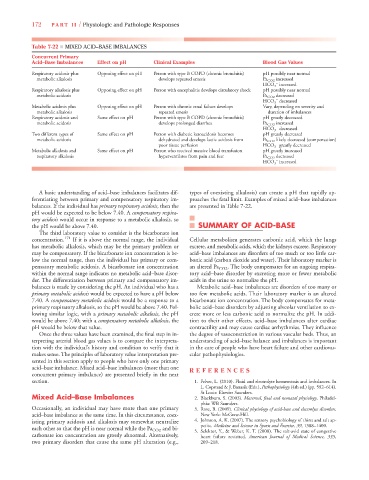
                  Table 7-22 ■ MIXED ACID–BASE IMBALANCES
                  Concurrent Primary
                  Acid–Base Imbalances  Effect on pH      Clinical Examples                   Blood Gas Values
                  Respiratory acidosis plus    Opposing effect on pH  Person with type B COPD (chronic bronchitis)  pH possibly near normal
                    metabolic alkalosis                     develops repeated emesis          Pa CO2 increased
                                                                                                  –
                                                                                              HCO 3 increased
                  Respiratory alkalosis plus  Opposing effect on pH  Person with encephalitis develops circulatory shock  pH possibly near normal
                    metabolic acidosis                                                        Pa CO2 decreased
                                                                                                  –
                                                                                              HCO 3 decreased
                  Metabolic acidosis plus   Opposing effect on pH  Person with chronic renal failure develops   Vary, depending on severity and
                    metabolic alkalosis                     repeated emesis                     duration of imbalances
                  Respiratory acidosis and   Same effect on pH  Person with type B COPD (chronic bronchitis)   pH greatly decreased
                    metabolic acidosis                      develops prolonged diarrhea       Pa CO2 increased
                                                                                                  –
                                                                                              HCO 3 decreased
                  Two different types of   Same effect on pH  Person with diabetic ketoacidosis becomes   pH greatly decreased
                    metabolic acidosis                      dehydrated and develops lactic acidosis from   Pa CO2 likely decreased (compensation)
                                                                                                  –
                                                            poor tissue perfusion             HCO 3 greatly decreased
                  Metabolic alkalosis and   Same effect on pH  Person who received massive blood transfusion   pH greatly increased
                    respiratory alkalosis                   hyperventilates from pain and fear  Pa CO2 decreased
                                                                                                  –
                                                                                              HCO 3 increased

                     A basic understanding of acid–base imbalances facilitates dif-  types of coexisting alkalosis) can create a pH that rapidly ap-
                  ferentiating between primary and compensatory respiratory im-  proaches the fatal limit. Examples of mixed acid–base imbalances
                  balances. If the individual has primary respiratory acidosis, then the  are presented in Table 7-22.
                  pH would be expected to be below 7.40. A compensatory respira-
                  tory acidosis would occur in response to a metabolic alkalosis, so
                  the pH would be above 7.40.                            SUMMARY OF ACID-BASE
                     The third laboratory value to consider is the bicarbonate ion
                  concentration. 171  If it is above the normal range, the individual  Cellular metabolism generates carbonic acid, which the lungs
                  has metabolic alkalosis, which may be the primary problem or  excrete, and metabolic acids, which the kidneys excrete. Respiratory
                  may be compensatory. If the bicarbonate ion concentration is be-  acid–base imbalances are disorders of too much or too little car-
                  low the normal range, then the individual has primary or com-  bonic acid (carbon dioxide and water). Their laboratory marker is
                  pensatory metabolic acidosis. A bicarbonate ion concentration  an altered Pa CO2 . The body compensates for an ongoing respira-
                  within the normal range indicates no metabolic acid–base disor-  tory acid–base disorder by excreting more or fewer metabolic
                  der. The differentiation between primary and compensatory im-  acids in the urine to normalize the pH.
                  balances is made by considering the pH. An individual who has a  Metabolic acid–base imbalances are disorders of too many or
                  primary metabolic acidosis would be expected to have a pH below  too few metabolic acids. Their laboratory marker is an altered
                  7.40. A compensatory metabolic acidosis would be a response to a  bicarbonate ion concentration. The body compensates for meta-
                  primary respiratory alkalosis, so the pH would be above 7.40. Fol-  bolic acid–base disorders by adjusting alveolar ventilation to ex-
                  lowing similar logic, with a primary metabolic alkalosis, the pH  crete more or less carbonic acid to normalize the pH. In addi-
                  would be above 7.40; with a compensatory metabolic alkalosis, the  tion to their other effects, acid–base imbalances alter cardiac
                  pH would be below that value.                       contractility and may cause cardiac arrhythmias. They influence
                     Once the three values have been examined, the final step in in-  the degree of vasoconstriction in various vascular beds. Thus, an
                  terpreting arterial blood gas values is to compare the interpreta-  understanding of acid–base balance and imbalances is important
                  tion with the individual’s history and condition to verify that it  in the care of people who have heart failure and other cardiovas-
                  makes sense. The principles of laboratory value interpretation pre-  cular pathophysiologies.
                  sented in this section apply to people who have only one primary
                  acid–base imbalance. Mixed acid–base imbalances (more than one  REFE R E NC ES
                  concurrent primary imbalance) are presented briefly in the next
                  section.                                              1. Felver, L. (2010). Fluid and electrolyte homeostasis and imbalances. In
                                                                          L. Copstead & J. Banasik (Eds.), Pathophysiology (4th ed.) (pp. 592–614).
                                                                          St Louis: Elsevier Saunders.
                  Mixed Acid–Base Imbalances                            2. Blackburn, S. (2003). Maternal, fetal and neonatal physiology. Philadel-
                                                                          phia: WB Saunders.
                  Occasionally, an individual may have more than one primary  3. Rose, B. (2009). Clinical physiology of acid-base and electrolyte disorders.
                  acid–base imbalance at the same time. In this circumstance, coex-  New York: McGraw-Hill.
                  isting primary acidosis and alkalosis may somewhat neutralize  4. Johnson, A. K. (2007). The sensory psychobiology of thirst and salt ap-
                                                                          petite. Medicine and Science in Sports and Exercise, 39, 1388–1400.
                  each other so that the pH is near normal while the Pa CO2 and bi-  5. Selektor, Y., & Weber, K. T. (2008). The salt-avid state of congestive
                  carbonate ion concentration are grossly abnormal. Alternatively,  heart failure revisited.  American Journal of Medical Science, 335,
                  two primary disorders that cause the same pH alteration (e.g.,  209–218.

