


Page 192 - Cardiac Nursing
P. 192
LWBK340-c07_p153-176.qxd  6/29/09  10:14 PM  Page 168 Aptara Inc.


                  168    PA R T  II / Physiologic and Pathologic Responses


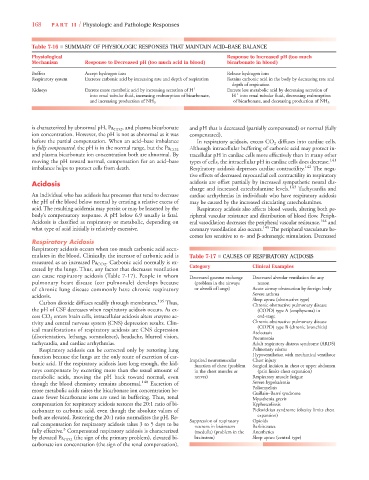
                  Table 7-16 ■ SUMMARY OF PHYSIOLOGIC RESPONSES THAT MAINTAIN ACID–BASE BALANCE
                  Physiological                                                   Response to Increased pH (too much
                  Mechanism         Response to Decreased pH (too much acid in blood)  bicarbonate in blood)
                  Buffers           Accept hydrogen ions                          Release hydrogen ions
                  Respiratory system  Excretes carbonic acid by increasing rate and depth of respiration  Retains carbonic acid in the body by decreasing rate and
                                                                                    depth of respiration
                  Kidneys           Excrete more metabolic acid by increasing secretion of H
  Excrete less metabolic acid by decreasing secretion of

                                     into renal tubular fluid, increasing reabsorption of bicarbonate,  H into renal tubular fluid, decreasing reabsorption
                                     and increasing production of NH 3              of bicarbonate, and decreasing production of NH 3


                  is characterized by abnormal pH, Pa CO2 , and plasma bicarbonate  and pH that is decreased (partially compensated) or normal (fully
                  ion concentration. However, the pH is not as abnormal as it was  compensated).
                  before the partial compensation. When an acid–base imbalance  In respiratory acidosis, excess CO 2 diffuses into cardiac cells.
                               d
                               d
                  is fully compensated, the pH is in the normal range, but the Pa CO2  Although intracellular buffering of carbonic acid may protect in-
                  and plasma bicarbonate ion concentration both are abnormal. By  tracellular pH in cardiac cells more effectively than in many other
                  moving the pH toward normal, compensation for an acid–base  types of cells, the intracellular pH in cardiac cells does decrease. 141
                  imbalance helps to protect cells from death.        Respiratory acidosis depresses cardiac contractility. 142  The nega-
                                                                      tive effects of decreased myocardial cell contractility in respiratory
                  Acidosis                                            acidosis are offset partially by increased sympathetic neural dis-
                                                                      charge and increased catecholamine levels. 143  Tachycardia and
                  An individual who has acidosis has processes that tend to decrease  cardiac arrhythmias in individuals who have respiratory acidosis
                  the pH of the blood below normal by creating a relative excess of  may be caused by the increased circulating catecholamines.
                  acid. The resulting acidemia may persist or may be lessened by the  Respiratory acidosis also affects blood vessels, altering both pe-
                  body’s compensatory response. A pH below 6.9 usually is fatal.  ripheral vascular resistance and distribution of blood flow. Periph-
                  Acidosis is classified as respiratory or metabolic, depending on  eral vasodilation decreases the peripheral vascular resistance. 144  and
                  what type of acid initially is relatively excessive.  coronary vasodilation also occurs. 145  The peripheral vasculature be-
                                                                      comes less sensitive to  - and  -adrenergic stimulation. Decreased
                  Respiratory Acidosis
                  Respiratory acidosis occurs when too much carbonic acid accu-
                  mulates in the blood. Clinically, the increase of carbonic acid is  Table 7-17 ■ CAUSES OF RESPIRATORY ACIDOSIS
                  measured as an increased Pa CO2 . Carbonic acid normally is ex-
                  creted by the lungs. Thus, any factor that decreases ventilation  Category  Clinical Examples
                  can cause respiratory acidosis (Table 7-17). People in whom  Decreased gaseous exchange  Decreased alveolar ventilation for any
                  pulmonary heart disease (cor  pulmonale) develops because  (problem in the airways    reason
                  of chronic lung disease commonly have chronic respiratory   or alveoli of lungs)  Acute airway obstruction by foreign body
                  acidosis.                                                                Severe asthma
                                                                                           Sleep apnea (obstructive type)
                     Carbon dioxide diffuses readily through membranes. 135  Thus,         Chronic obstructive pulmonary disease
                  the pH of CSF decreases when respiratory acidosis occurs. As ex-          (COPD) type A (emphysema) in
                  cess CO 2 enters brain cells, intracellular acidosis alters enzyme ac-    end-stage
                  tivity and central nervous system (CNS) depression results. Clin-        Chronic obstructive pulmonary disease
                                                                                            (COPD) type B (chronic bronchitis)
                  ical manifestations of respiratory acidosis are CNS depression           Atelectasis
                  (disorientation, lethargy, somnolence), headache, blurred vision,        Pneumonia
                  tachycardia, and cardiac arrhythmias.                                    Adult respiratory distress syndrome (ARDS)
                     Respiratory acidosis can be corrected only by restoring lung          Pulmonary edema
                  function because the lungs are the only route of excretion of car-  Impaired neuromuscular  Hypoventilation with mechanical ventilator
                                                                                           Chest injury
                  bonic acid. If the respiratory acidosis lasts long enough, the kid-  function of chest (problem   Surgical incision in chest or upper abdomen
                  neys compensate by excreting more than the usual amount of  in the chest muscles or   (pain limits chest expansion)
                  metabolic acids, moving the pH  back toward normal, even  nerves)        Respiratory muscle fatigue
                  though the blood chemistry remains abnormal. 140  Excretion of           Severe hypokalemia
                  more metabolic acids raises the bicarbonate ion concentration be-        Poliomyelitis
                                                                                           Guillain–Barré syndrome
                  cause fewer bicarbonate ions are used in buffering. Thus, renal          Myasthenia gravis
                  compensation for respiratory acidosis restores the 20:1 ratio of bi-     Kyphoscoliosis
                  carbonate to carbonic acid, even though the absolute values of           Pickwickian syndrome (obesity limits chest
                                                                                            expansion)
                  both are elevated. Restoring the 20:1 ratio normalizes the pH. Re-  Suppression of respiratory   Opioids
                  nal compensation for respiratory acidosis takes 3 to 5 days to be  neurons in brainstem  Barbiturates
                             3
                  fully effective. Compensated respiratory acidosis is characterized  (medulla) (problem in the  Anesthetics
                  by elevated Pa CO2 (the sign of the primary problem), elevated bi-  brainstem)  Sleep apnea (central type)
                  carbonate ion concentration (the sign of the renal compensation),

