


Page 194 - Cardiac Nursing
P. 194
LWBK340-c07_p153-176.qxd  6/29/09  10:14 PM  Page 170 Aptara Inc.


                  170    PA R T  II / Physiologic and Pathologic Responses


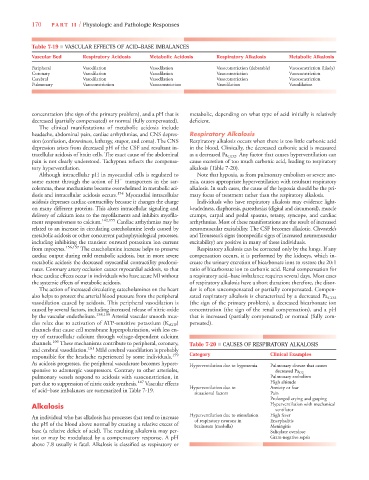
                  Table 7-19 ■ VASCULAR EFFECTS OF ACID–BASE IMBALANCES
                  Vascular Bed     Respiratory Acidosis  Metabolic Acidosis    Respiratory Alkalosis   Metabolic Alkalosis
                  Peripheral       Vasodilation          Vasodilation          Vasoconstriction (debatable)  Vasoconstriction (likely)
                  Coronary         Vasodilation          Vasodilation          Vasoconstriction        Vasoconstriction
                  Cerebral         Vasodilation          Vasodilation          Vasoconstriction        Vasoconstriction
                  Pulmonary        Vasoconstriction      Vasoconstriction      Vasodilation            Vasodilation


                  concentration (the sign of the primary problem), and a pH that is  metabolic, depending on what type of acid initially is relatively
                  decreased (partially compensated) or normal (fully compensated).  deficient.
                     The clinical manifestations of metabolic acidosis include
                  headache, abdominal pain, cardiac arrhythmias, and CNS depres-  Respiratory Alkalosis
                  sion (confusion, drowsiness, lethargy, stupor, and coma). The CNS  Respiratory alkalosis occurs when there is too little carbonic acid
                  depression arises from decreased pH of the CSF and resultant in-  in the blood. Clinically, the decreased carbonic acid is measured
                  tracellular acidosis of brain cells. The exact cause of the abdominal  as a decreased Pa CO2 . Any factor that causes hyperventilation can
                  pain is not clearly understood. Tachypnea reflects the compensa-  cause excretion of too much carbonic acid, leading to respiratory
                  tory hyperventilation.                              alkalosis (Table 7-20).
                     Although intracellular pH in myocardial cells is regulated to  Note that hypoxia, as from pulmonary embolism or severe ane-
                  some extent through the action of H
  transporters in the sar-  mia, causes appropriate hyperventilation with resultant respiratory
                  colemma, these mechanisms become overwhelmed in metabolic aci-  alkalosis. In such cases, the cause of the hypoxia should be the pri-
                  dosis and intracellular acidosis occurs. 154  Myocardial intracellular  mary focus of treatment rather than the respiratory alkalosis.
                  acidosis depresses cardiac contractility because it changes the charge  Individuals who have respiratory alkalosis may evidence light-
                  on many different proteins. This alters intracellular signaling and  headedness, diaphoresis, paresthesias (digital and circumoral), muscle
                  delivery of calcium ions to the myofilaments and inhibits myofila-  cramps, carpal and pedal spasms, tetany, syncope, and cardiac
                  ment responsiveness to calcium. 142,155  Cardiac arrhythmias may be  arrhythmias. Most of these manifestations are the result of increased
                  related to an increase in circulating catecholamine levels caused by  neuromuscular excitability. The CSF becomes alkalotic. Chvostek’s
                  metabolic acidosis or other concurrent pathophysiological processes,  and Trousseau’s signs (nonspecific signs of increased neuromuscular
                  including inhibiting the transient outward potassium ion current  excitability) are positive in many of these individuals.
                  from myocytes. 156,157  The catecholamine increase helps to preserve  Respiratory alkalosis can be corrected only by the lungs. If any
                  cardiac output during mild metabolic acidosis, but in more severe  compensation occurs, it is performed by the kidneys, which in-
                  metabolic acidosis the decreased myocardial contractility predomi-  crease the urinary excretion of bicarbonate ions to restore the 20:1
                  nates. Coronary artery occlusion causes myocardial acidosis, so that  ratio of bicarbonate ion to carbonic acid. Renal compensation for
                  these cardiac effects occur in individuals who have acute MI without  a respiratory acid–base imbalance requires several days. Most cases
                  the systemic effects of metabolic acidosis.         of respiratory alkalosis have a short duration; therefore, the disor-
                     The action of increased circulating catecholamines on the heart  der is often uncompensated or partially compensated. Compen-
                  also helps to protect the arterial blood pressure from the peripheral  sated respiratory alkalosis is characterized by a decreased Pa CO2
                  vasodilation caused by acidosis. This peripheral vasodilation is  (the sign of the primary problem), a decreased bicarbonate ion
                  caused by several factors, including increased release of nitric oxide  concentration (the sign of the renal compensation), and a pH
                  by the vascular endothelium. 158,159  Arterial vascular smooth mus-  that is increased (partially compensated) or normal (fully com-
                  cles relax due to activation of ATP-sensitive potassium (K ATP )  pensated).
                                                              K
                  channels that cause cell membrane hyperpolarization, with less en-
                  try of extracellular calcium through voltage-dependent calcium
                  channels. 160  These mechanisms contribute to peripheral, coronary,  Table 7-20 ■ CAUSES OF RESPIRATORY ALKALOSIS
                  and cerebral vasodilation. 161  Mild cerebral vasodilation is probably
                  responsible for the headache experienced by some individuals. 159  Category   Clinical Examples
                  As acidosis progresses, the peripheral vasculature becomes hypore-  Hyperventilation due to hypoxemia  Pulmonary disease that causes
                  sponsive to adrenergic vasopressors. Contrary to other arterioles,              decreased Pa O2
                  pulmonary vessels respond to acidosis with vasoconstriction, in               Pulmonary embolism
                  part due to suppression of nitric oxide synthesis. 147  Vascular effects      High altitude
                  of acid–base imbalances are summarized in Table 7-19.  Hyperventilation due to  Anxiety or fear
                                                                        situational factors     Pain
                                                                                                Prolonged crying and gasping
                  Alkalosis                                                                     Hyperventilation with mechanical
                                                                                                  ventilator
                  An individual who has alkalosis has processes that tend to increase  Hyperventilation due to stimulation  High fever
                                                                        of respiratory neurons in
                                                                                                Encephalitis
                  the pH of the blood above normal by creating a relative excess of  brainstem (medulla)  Meningitis
                  base (a relative deficit of acid). The resulting alkalemia may per-            Salicylate overdose
                  sist or may be modulated by a compensatory response. A pH                     Gram-negative sepsis
                  above 7.8 usually is fatal. Alkalosis is classified as respiratory or

