


Page 265 - Cardiac Nursing
P. 265
6/2
                                  009
                                6/2
                              0/0
                              0/0
                                      0:4
                                      0:4
                                     1
                                  009
                                     1
                             3
                        44.
                          q
                        44.
                      1-2
                      1-2
                           xd
                             3
                           xd
                          q
                          q
                                        7 A
                                                   p
                                                   p
                                                  A
                                                41
                                                  A
                                                     ara
                                                     ara
                                                    t
                                                   p
                                                    t
                                                41
                                            Pa
                                            Pa
                                          M
                                        7 A
                                          M
                                               e 2
                                               e 2
                                              g
                                              g
                                              g
         LWBK340-c10_
         LWB
                   p
                 10_
               0-c
            K34
                    21
         LWB K34 0-c 10_ pp211-244.qxd  30/06/2009  10:47 AM  Page 241 Aptara
                   p
                    21
                                                               C HAPTER 1 0 / History Taking and Physical Examination  241
                   Table 10-8 ■ PERCUSSION NOTES AND THEIR CHARACTERISTICS
                                     Relative Intensity   Relative Pitch     Relative Duration     Example of Location
                   Flatness          Soft                 High               Short                 Thigh
                   Dullness          Medium                Medium            Medium                Liver
                   Resonance         Loud                 Low                Long                  Normal lung
                   Hyperresonance    Very loud             Lower             Longer                None normally
                   Tympany           Loud                  High *            *                     Gastric air bubble or puffed-
                                                                                                    out cheek
                   *Distinguished mainly by its musical timbre.
                   Bickley, L. S., & Szilagyi, P. G. (2009). Bates’ guide to physical examination and history taking (10th ed.). Philadelphia: Lippincott Williams & Wilkins.
                   replaces resonance when fluid or solid tissue replaces air-filled tis-  Bronchial sounds, heard normally over the bronchial areas, are
                   sue. In patients with emphysema and air trapping, hyper-resonance  loud and high pitched. Expiratory time is greater than inspira-
                   replaces resonance. Diaphragmatic excursion can be ascertained by  tory time. If heard in the lung periphery, bronchial sounds are
                   percussion of the border between resonance (lung tissue) and dull-  abnormal.
                   ness (muscle) in expiration and inspiration. Normal excursion is  Adventitious  breath sounds are superimposed over normal
                   5 to 6 cm.                                          breath sounds. There are two categories of adventitious sounds:
                                                                       discontinuous (crackles) and continuous (wheezes and pleural
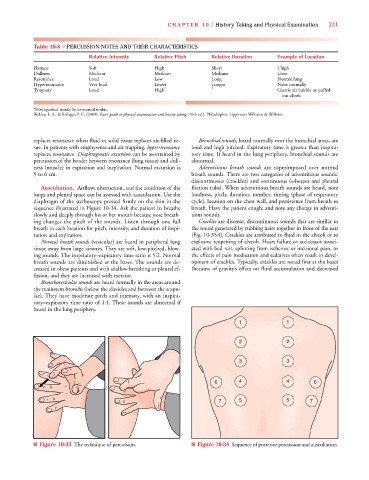
                     Auscultation. Airflow, obstruction, and the condition of the  friction rubs). When adventitious breath sounds are heard, note
                   lungs and pleural space can be assessed with auscultation. Use the  loudness, pitch, duration, number, timing (phase of respiratory
                   diaphragm of the stethoscope pressed firmly on the skin in the  cycle), location on the chest wall, and persistence from breath to
                   sequence illustrated in Figure 10-34. Ask the patient to breathe  breath. Have the patient cough, and note any change in adventi-
                   slowly and deeply through his or her mouth because nose breath-  tious sounds.
                   ing changes the pitch of the sounds. Listen through one full  Crackles are discrete, discontinuous sounds that are similar to
                   breath in each location for pitch, intensity, and duration of inspi-  the sound generated by rubbing hairs together in front of the ears
                   ration and expiration.                              (Fig. 10-35A). Crackles are attributed to fluid in the alveoli or to
                     Normal breath sounds (vesicular) are heard in peripheral lung  explosive reopening of alveoli. Heart failure or atelectasis associ-
                   tissue away from large airways. They are soft, low-pitched, blow-  ated with bed rest, splinting from ischemic or incisional pain, or
                   ing sounds. The inspiratory–expiratory time ratio is 5:2. Normal  the effects of pain medication and sedatives often result in devel-
                   breath sounds are diminished at the bases. The sounds are de-  opment of crackles. Typically, crackles are noted first at the bases
                   creased in obese patients and with shallow breathing or pleural ef-  (because of gravity’s effect on fluid accumulation and decreased
                   fusion, and they are increased with exercise.
                     Bronchovesicular sounds are heard normally in the areas around
                   the mainstem bronchi (below the clavicles and between the scapu-
                   lae). They have moderate pitch and intensity, with an inspira-
                   tory–expiratory time ratio of 1:1. These sounds are abnormal if
                   heard in the lung periphery.
                                                                                      1               1
                                                                                      2               2
                                                                                      3               3
                                                                              6       4               4        6
                                                                                7     5               5      7
                   ■ Figure 10-33 The technique of percussion.         ■ Figure 10-34 Sequence of posterior percussion and auscultation.

