


Page 264 - Cardiac Nursing
P. 264
6/2
                                  009
                                6/2
                              0/0
                              0/0
                                      0:4
                                      0:4
                                     1
                                  009
                                     1
                             3
                        44.
                          q
                        44.
                      1-2
                      1-2
                           xd
                             3
                           xd
                          q
                          q
                                        7 A
                                                   p
                                                   p
                                                  A
                                                40
                                                  A
                                                     ara
                                                     ara
                                                    t
                                                   p
                                                    t
                                                40
                                            Pa
                                            Pa
                                          M
                                        7 A
                                          M
                                               e 2
                                               e 2
                                              g
                                              g
                                              g
         LWBK340-c10_ p p pp211-244.qxd  30/06/2009  10:47 AM  Page 240 Aptara
            K34
                    21
                    21
            K34
                 10_
                 10_
               0-c
               0-c
                  240    P A R T  III / Assessment of Heart Disease
                       Cross section                                               Spinal convexity to the right
                       of thorax                                                   (patient bending forward)
                                                                                                                Ribs
                                                                                                               widely
                                                                                                            se parated
                                                                                      Ribs
                                                                                      close
                                                                                      together
                      A                             B                              C
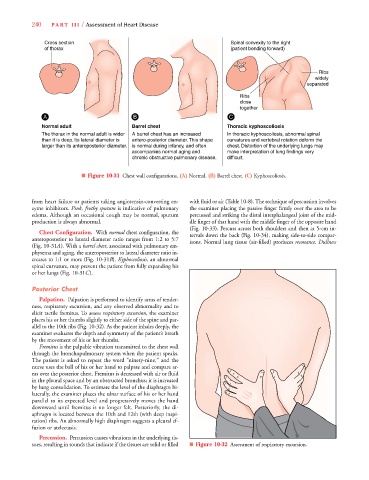
                      Normal adult                 Barrel chest                   Thoracic kyphoscoliosis
                      The thorax in the normal adult is wider   A barrel chest has an increased   In thoracic kyphoscoliosis, abnormal spinal
                      than it is deep. Its lateral diameter is  antero-posterior diameter. This shape   curvatures and vertebral rotation deform the
                      larger than its anteroposterior diameter. is normal during infancy, and often  chest. Distortion of the underlying lungs may
                                                   accompanies normal aging and   make interpretation of lung findings very
                                                   chronic obstructive pulmonary disease.  difficult.
                                   ■ Figure 10-31 Chest wall configurations. (A) Normal. (B) Barrel chest. (C) Kyphoscoliosis.
                  from heart failure or patients taking angiotensin-converting en-  with fluid or air (Table 10-8). The technique of percussion involves
                  zyme inhibitors. Pink, frothy sputum is indicative of pulmonary  the examiner placing the passive finger firmly over the area to be
                  edema. Although an occasional cough may be normal, sputum  percussed and striking the distal interphalangeal joint of the mid-
                  production is always abnormal.                      dle finger of that hand with the middle finger of the opposite hand
                                                                      (Fig. 10-33). Percuss across both shoulders and then at 5-cm in-
                     Chest Configuration. With normal chest configuration, the  tervals down the back (Fig. 10-34), making side-to-side compar-
                  anteroposterior to lateral diameter ratio ranges from 1:2 to 5:7  isons. Normal lung tissue (air-filled) produces resonance. Dullness
                                          t
                  (Fig. 10-31A). With a barrel chest, associated with pulmonary em-
                                          t
                  physema and aging, the anteroposterior to lateral diameter ratio in-
                  creases to 1:1 or more (Fig. 10-31B). Kyphoscoliosis, an abnormal
                                            B
                  spinal curvature, may prevent the patient from fully expanding his
                  or her lungs (Fig. 10-31C).
                  Posterior Chest
                     Palpation. Palpation is performed to identify areas of tender-
                  ness, respiratory excursion, and any observed abnormality and to
                  elicit tactile fremitus. To assess respiratory excursion, the examiner
                  places his or her thumbs slightly to either side of the spine and par-
                  allel to the 10th ribs (Fig. 10-32). As the patient inhales deeply, the
                  examiner evaluates the depth and symmetry of the patient’s breath
                  by the movement of his or her thumbs.
                     Fremitus is the palpable vibration transmitted to the chest wall
                  through the bronchopulmonary system when the patient speaks.
                  The patient is asked to repeat the word “ninety-nine,” and the
                  nurse uses the ball of his or her hand to palpate and compare ar-
                  eas over the posterior chest. Fremitus is decreased with air or fluid
                  in the pleural space and by an obstructed bronchus; it is increased
                  by lung consolidation. To estimate the level of the diaphragm bi-
                  laterally, the examiner places the ulnar surface of his or her hand
                  parallel to its expected level and progressively moves the hand
                  downward until fremitus is no longer felt. Posteriorly, the di-
                  aphragm is located between the 10th and 12th (with deep inspi-
                  ration) ribs. An abnormally high diaphragm suggests a pleural ef-
                  fusion or atelectasis.
                     Percussion. Percussion causes vibrations in the underlying tis-
                  sues, resulting in sounds that indicate if the tissues are solid or filled  ■ Figure 10-32 Assessment of respiratory excursion.

