


Page 261 - Cardiac Nursing
P. 261
LWBK340-c10_p211-244.qxd  30/06/2009  10:47 AM  Page 237 Aptara


                                                               C HAP TE R 1 0 / History Taking and Physical Examination  237

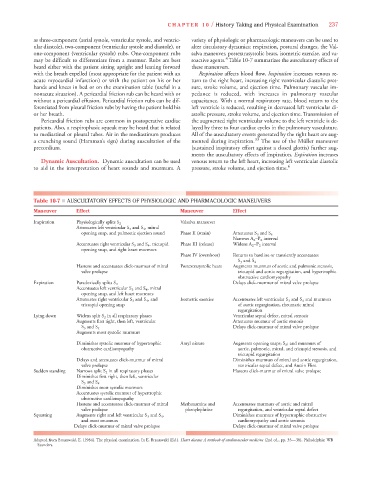
                   as three-component (atrial systole, ventricular systole, and ventric-  variety of physiologic or pharmacologic maneuvers can be used to
                   ular diastole), two-component (ventricular systole and diastole), or  alter circulatory dynamics: respiration, postural changes, the Val-
                   one-component (ventricular systole) rubs. One-component rubs  salva maneuver, postextrasystolic beats, isometric exercise, and va-
                                                                                  8
                   may be difficult to differentiate from a murmur. Rubs are best  soactive agents. Table 10-7 summarizes the auscultatory effects of
                   heard either with the patient sitting upright and leaning forward  these maneuvers.
                   with the breath expelled (most appropriate for the patient with an  Respiration affects blood flow. Inspiration increases venous re-
                   acute myocardial infarction) or with the patient on his or her  turn to the right heart, increasing right ventricular diastolic pres-
                   hands and knees in bed or on the examination table (useful in a  sure, stroke volume, and ejection time. Pulmonary vascular im-
                   nonacute situation). A pericardial friction rub can be heard with or  pedance is reduced, with increases in pulmonary vascular
                   without a pericardial effusion. Pericardial friction rubs can be dif-  capacitance. With a normal respiratory rate, blood return to the
                   ferentiated from pleural friction rubs by having the patient hold his  left ventricle is reduced, resulting in decreased left ventricular di-
                   or her breath.                                      astolic pressure, stroke volume, and ejection time. Transmission of
                     Pericardial friction rubs are common in postoperative cardiac  the augmented right ventricular volume to the left ventricle is de-
                   patients. Also, a respirophasic squeak may be heard that is related  layed by three to four cardiac cycles in the pulmonary vasculature.
                   to mediastinal or pleural tubes. Air in the mediastinum produces  All of the auscultatory events generated by the right heart are aug-
                   a crunching sound (Hamman’s sign) during auscultation of the  mented during inspiration. 33  The use of the Müller maneuver
                   precordium.                                         (sustained inspiratory effort against a closed glottis) further aug-
                                                                       ments the auscultatory effects of inspiration. Expiration increases
                     Dynamic Auscultation. Dynamic auscultation can be used  venous return to the left heart, increasing left ventricular diastolic
                   to aid in the interpretation of heart sounds and murmurs. A  pressure, stroke volume, and ejection time. 6


                   Table 10-7 ■ AUSCULTATORY EFFECTS OF PHYSIOLOGIC AND PHARMACOLOGIC MANEUVERS
                   Maneuver      Effect                            Maneuver         Effect
                   Inspiration   Physiologically splits S 2        Valsalva maneuver
                                 Attenuates left ventricular S 3 and S 4 , mitral
                                   opening snap, and pulmonic ejection sound  Phase II (strain)  Attenuates S 3 and S 4
                                                                                          A
                                                                                    Narrows A 2 –P 2 interval
                                 Accentuates right ventricular S 3 and S 4 , tricuspid  Phase III (release)  Widens A 2 –P 2 interval
                                                                                         A
                                   opening snap, and right heart murmurs
                                                                   Phase IV (overshoot)  Returns to baseline or transiently accentuates
                                                                                      S 3 and S 4
                                 Hastens and accentuates click-murmur of mitral  Postextrasystolic beats  Augments murmurs of aortic and pulmonic stenosis,
                                   valve prolapse                                     tricuspid and aortic regurgitation, and hypertrophic
                                                                                      obstructive cardiomyopathy
                   Expiration    Paradoxically splits S 2                           Delays click-murmur of mitral valve prolapse
                                 Accentuates left ventricular S 3 and S 4 , mitral
                                   opening snap, and left heart murmurs
                                 Attenuates right ventricular S 3 and S 4 , and  Isometric exercise  Accentuates left ventricular S 3 and S 4 and murmurs
                                   tricuspid opening snap                             of aortic regurgitation, rheumatic mitral
                                                                                      regurgitation
                   Lying down    Widens split S 2 in all respiratory phases         Ventricular septal defect, mitral stenosis
                                 Augments first right, then left, ventricular        Attenuates murmur of aortic stenosis
                                                                                    Delays click-murmur of mitral valve prolapse
                                   S 3 and S 4
                                 Augments most systolic murmurs
                                 Diminishes systolic murmur of hypertrophic  Amyl nitrate  Augments opening snaps; S 3 ; and murmurs of
                                   obstructive cardiomyopathy                         aortic, pulmonic, mitral, and tricuspid stenosis, and
                                                                                      tricuspid regurgitation
                                 Delays and attenuates click-murmur of mitral       Diminishes murmurs of mitral and aortic regurgitation,
                                   valve prolapse                                     ventricular septal defect, and Austin Flint
                   Sudden standing  Narrows split S 2 in all respiratory phases     Hastens click-murmur of mitral valve prolapse
                                 Diminishes first right, then left, ventricular
                                   S 3 and S 4
                                 Diminishes most systolic murmurs
                                 Accentuates systolic murmur of hypertrophic
                                   obstructive cardiomyopathy
                                 Hastens and accentuates click-murmur of mitral   Methoxamine and  Accentuates murmurs of aortic and mitral
                                   valve prolapse                    phenylephrine    regurgitation, and ventricular septal defect
                   Squatting     Augments right and left ventricular S 3 and S 4 ,   Diminishes murmurs of hypertrophic obstructive
                                   and most murmurs                                   cardiomyopathy and aortic stenosis
                                Delays click-murmur of mitral valve prolapse        Delays click-murmur of mitral valve prolapse

                   Adapted from Braunwald, E. (1984). The physical examination. In E. Braunwald (Ed.). Heart disease: A textbook of cardiovascular medicine (2nd ed., pp. 35—38). Philadelphia: WB
                    Saunders.

