


Page 260 - Cardiac Nursing
P. 260
q
                          q
                        44.
                      1-2
                        44.
                          q
                             3
                              0/0
                             3
                           xd
                           xd
                      1-2
                                                    t
                                                   p
                                                    t
                                                     ara
                                                     ara
                   p
                                                   p
                                                   p
                    21
                   p
                    21
                              0/0
                                              g
                                              g
                                              g
                                            Pa
                                            Pa
                                               e 2
                                                  A
                                                  A
                                                36
                                               e 2
                                                36
                                          M
                                  009
                                     1
                                  009
                                6/2
                                6/2
                                     1
                                        7 A
                                          M
                                        7 A
                                      0:4
                                      0:4
            K34
            K34
         LWB
         LWBK340-c10_ pp211-244.qxd  30/06/2009  10:47 AM  Page 236 Aptara
         LWB
                 10_
                 10_
               0-c
               0-c
                  236    P A R T  III / Assessment of Heart Disease
                                                                      muscle rupture because of the development of sudden and pro-
                                                                      found heart failure.
                               S      S
                            A   1      2      B  S 1   S 2              In the setting of acute aortic dissection, coronary artery bypass
                                                                      grafting with a friable aorta, or aortic valve replacement, new-onset
                                                                      aortic insufficiency indicates retrograde dissection of the aorta, or
                               S      S
                            C   1      2      D  S 1   S 2            valve dehiscence. The murmur of aortic insufficiency is an early
                                                                      diastolic, decrescendo murmur, heard at the second right or third
                                                                      left ICS that radiates toward the apex. In acute aortic insuffi-
                                   E   S 1    S 2
                                                                      ciency, the intensity of S 1 is frequently diminished because of the
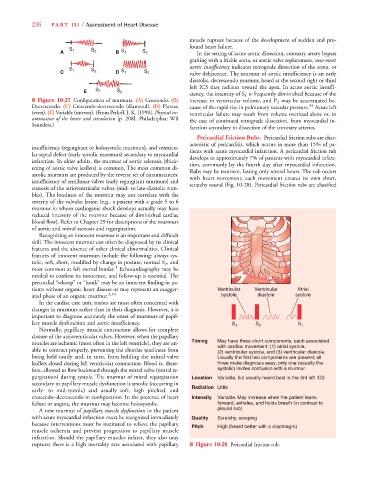
                  ■ Figure 10-27 Configuration of murmurs. (A) Crescendo. (B)  increase in ventricular volume, and P 2 may be accentuated be-
                                                                                                             33
                  Decrescendo. (C) Crescendo-decrescendo (diamond). (D) Plateau  cause of the rapid rise in pulmonary vascular pressure. Acute left
                  (even). (E) Variable (uneven). (From Perloff, J. K. [1990]. Physical ex-  ventricular failure may result from volume overload alone or, in
                  amination of the heart and circulation [p. 208]. Philadelphia: WB  the case of continued retrograde dissection, from myocardial in-
                  Saunders.)
                                                                      farction secondary to dissection of the coronary arteries.
                                                                        Pericardial Friction Rubs. Pericardial friction rubs are char-
                                                                      acteristic of pericarditis, which occurs in more than 15% of pa-
                  insufficiency (regurgitant or holosystolic murmurs), and ventricu-  tients with acute myocardial infarction. A pericardial friction rub
                  lar septal defect (early systolic murmurs) secondary to myocardial  develops in approximately 7% of patients with myocardial infarc-
                  infarction. In older adults, the murmur of aortic sclerosis (thick-  tion, commonly by the fourth day after myocardial infarction.
                  ening of aortic valve leaflets) is common. The most common di-  Rubs may be transient, lasting only several hours. The rub occurs
                  astolic murmurs are produced by the reverse set of circumstances:  with  heart movement; each movement creates its own short,
                  insufficiency of semilunar valves (early regurgitant murmurs) and  scratchy sound (Fig. 10-28). Pericardial friction rubs are classified
                  stenosis of the atrioventricular valves (mid- to late-diastolic rum-
                  bles). The loudness of the murmur may not correlate with the
                  severity of the valvular lesion (e.g., a patient with a grade 5 to 6
                  murmur in whom cardiogenic shock develops actually may have
                  reduced intensity of the murmur because of diminished cardiac
                  blood flow). Refer to Chapter 29 for descriptions of the murmurs
                  of aortic and mitral stenosis and regurgitation.
                     Recognizing an innocent murmur is an important and difficult
                  skill. The innocent murmur can often be diagnosed by its clinical
                  features and the absence of other clinical abnormalities. Clinical
                  features of innocent murmurs include the following: always sys-
                  tolic, soft, short, modified by change in posture, normal S 2 , and
                                              3
                  most common at left sternal border. Echocardiography may be
                  needed to confirm its innocence, and follow-up is essential. The
                  precordial “whoop” or “honk” may be an innocent finding in pa-
                  tients without organic heart disease or may represent an exagger-  Ventricular  Ventricular  Atrial
                  ated phase of an organic murmur. 3,33                         systole     diastole     systole
                     In the cardiac care unit, nurses are most often concerned with
                  changes in murmurs rather than in their diagnosis. However, it is
                  important to diagnose accurately the onset of murmurs of papil-
                  lary muscle dysfunction and aortic insufficiency.                  S 1     S 2          S 1
                     Normally, papillary muscle contraction allows for complete
                  closure of the atrioventricular valves. However, when the papillary
                  muscles are ischemic (most often in the left ventricle), they are un-  Timing  May have three short components, each associated
                                                                               with cardiac movement: (1) atrial systole,
                  able to contract properly, preventing the chordae tendineae from  (2) ventricular systole, and (3) ventricular diastole.
                  being held tautly and, in turn, from holding the mitral valve  Usually the first two components are present; all
                  leaflets closed during left ventricular contraction. Blood is, there-  three make diagnosis easy; only one (usually the
                  fore, allowed to flow backward through the mitral valve (mitral re-  systolic) invites confusion with a murmur.
                  gurgitation) during systole. The murmur of mitral regurgitation  Location  Variable, but usually heard best in the 3rd left ICS
                  secondary to papillary muscle dysfunction is systolic (occurring in
                  early- to mid-systole) and usually soft, high pitched, and  Radiation Little
                  crescendo–decrescendo in configuration. In the presence of heart  Intensity  Variable. May increase when the patient leans
                  failure or angina, the murmur may become holosystolic.       forward, exhales, and holds breath (in contrast to
                     A new murmur of papillary muscle dysfunction in the patient  pleural rub)
                  with acute myocardial infarction must be recognized immediately  Quality  Scratchy, scraping
                  because interventions must be instituted to relieve the papillary  Pitch  High (heard better with a diaphragm)
                  muscle ischemia and prevent progression to papillary muscle
                  infarction. Should the papillary muscles infarct, they also may
                  rupture; there is a high mortality rate associated with papillary  ■ Figure 10-28 Pericardial friction rub.

