


Page 263 - Cardiac Nursing
P. 263
009
                                  009
                                6/2
                              0/0
                                6/2
                                      0:4
                                        7 A
                                      0:4
                                     1
                                     1
                              0/0
                          q
                          q
                        44.
                      1-2
                        44.
                             3
                             3
                           xd
                          q
                           xd
                                                   p
                                                   p
                                                  A
                                                39
                                                  A
                                                     ara
                                                     ara
                                                    t
                                                   p
                                                    t
                                                39
                                            Pa
                                            Pa
                                          M
                                        7 A
                                          M
                                               e 2
                                               e 2
                                              g
                                              g
                                              g
         LWBK340-c10_
                    21
            K34
                 10_
               0-c
         LWB K34 0-c 10_ p p pp211-244.qxd  30/06/2009  10:47 AM  Page 239 Aptara
                      1-2
                    21
         LWB
                                                               C HAPTER 1 0 / History Taking and Physical Examination  239
                   subaortic stenosis and mitral valve prolapse. Sudden standing has  tory manifestations seen in patients with heart disease. The room
                   the opposite effect; it reduces venous return and causes most  should be quiet and the patient’s chest exposed. Proceed in a sys-
                   murmurs, except hypertrophic cardiomyopathy and mitral valve  tematic manner: inspect, palpate, percuss, and auscultate. Always
                   prolapse, to decrease. Squatting simultaneously increases venous  compare one side with the other; always place the stethoscope in
                   return and systemic vascular resistance. 6          direct contact with the chest wall. Begin with examination of the
                     Postextrasystolic beats, if followed by a pause, increase ventricular  posterior chest, if possible, with the patient sitting upright and
                   filling and cardiac contractility. Similar hemodynamic changes oc-  arms folded across the chest. Follow with assessment of the ante-
                   cur with diastolic pauses in atrial fibrillation and sinus arrhythmia. 6  rior chest with the patient lying down. Only the upper and lower
                     Isometric exercise increases systemic vascular resistance, arterial  lobes of the lung are accessible by posterior chest examination; to
                   pressure, heart rate, cardiac output, left ventricular filling pressure,  assess the right middle lobe, the lateral and anterior chest must be
                   and heart size. Using a calibrated handgrip device, the patient sus-  examined (Fig. 10-29). 8
                   tains the handgrip for 20 to 30 seconds. The handgrip enhances
                   S 3 and S 4 and aortic regurgitant murmurs. Avoid isometric exer-  Inspection
                   cise in patients with myocardial ischemia or ventricular arrhyth-
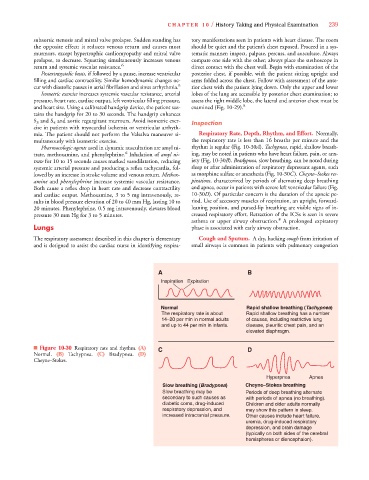
                   mia. The patient should not perform the Valsalva maneuver si-  Respiratory Rate, Depth, Rhythm, and Effort. Normally,
                   multaneously with isometric exercise.               the respiratory rate is less than 16 breaths per minute and the
                                                                                           0
                                                                                           0
                     Pharmacologic agents used in dynamic auscultation are amyl ni-  rhythm is regular (Fig. 10-30A). Tachypnea, rapid, shallow breath-
                                                 6
                   trate, methoxamine, and phenylephrine. Inhalation of amyl ni-  ing, may be noted in patients who have heart failure, pain, or anx-
                   trate for 10 to 15 seconds causes marked vasodilatation, reducing  iety (Fig. 10-30B).B Bradypnea, slow breathing, can be noted during
                   systemic arterial pressure and producing a reflex tachycardia, fol-  sleep or after administration of respiratory depressant agents, such
                   lowed by an increase in stroke volume and venous return. Methox-  as morphine sulfate or anesthesia (Fig. 10-30C). Cheyne–Stokes res-
                   amine and phenylephrine increase systemic vascular resistance.  pirations, characterized by periods of alternating deep breathing
                   Both cause a reflex drop in heart rate and decrease contractility  and apnea, occur in patients with severe left ventricular failure (Fig.
                   and cardiac output. Methoxamine, 3 to 5 mg intravenously, re-  10-30D). Of particular concern is the duration of the apneic pe-
                   sults in blood pressure elevation of 20 to 40 mm Hg, lasting 10 to  riod. Use of accessory muscles of respiration, an upright, forward-
                   20 minutes. Phenylephrine, 0.5 mg intravenously, elevates blood  leaning position, and pursed-lip breathing are visible signs of in-
                   pressure 30 mm Hg for 3 to 5 minutes.               creased respiratory effort. Retraction of the ICSs is seen in severe
                                                                                                   8
                                                                       asthma or upper airway obstruction. A prolonged expiratory
                   Lungs                                               phase is associated with early airway obstruction.
                   The respiratory assessment described in this chapter is elementary  Cough and Sputum. A dry, hacking cough from irritation of
                   and is designed to assist the cardiac nurse in identifying respira-  small airways is common in patients with pulmonary congestion
                                                            A                            B
                                                             Inspiration Expiration
                                                                                                                   a
                                                             Normal                      Rapid shallow breathing (Tachypnea)
                                                                                                                   a
                                                             The respiratory rate is about  Rapid shallow breathing has a number
                                                             14–20 per min in normal adults  of causes, including restrictive lung
                                                             and up to 44 per min in infants.  disease, pleuritic chest pain, and an
                                                                                        elevated diaphragm.
                   ■ Figure 10-30 Respiratory rate and rhythm. (A)  C                    D
                   Normal.  (B) Tachypnea.  (C) Bradypnea. (D)
                   Cheyne–Stokes.
                                                                                               Hyperpnea     Apnea
                                                                                 a
                                                             Slow breathing (Bradypnea)  Cheyne–Stokes breathing
                                                                                 a
                                                             Slow breathing may be      Periods of deep breathing alternate
                                                             secondary to such causes as  with periods of apnea (no breathing).
                                                             diabetic coma, drug-induced  Children and older adults normally
                                                             respiratory depression, and  may show this pattern in sleep.
                                                             increased intracranial pressure.  Other causes include heart failure,
                                                                                        uremia, drug-induced respiratory
                                                                                        depression, and brain damage
                                                                                        (typically on both sides of the cerebral
                                                                                        hemispheres or diencephalon).

